We visited the Knafs Knives home to see their new warehouse, and ended up taking pictures of drawings and haikus.
It’s a brisk, blue-skied morning outside the Knafs headquarters in Clearfield, Utah where we’re greeted by Austin Goetz, general manager and co-host of Knafs at Nite. He’s in shorts and a sweatshirt and we can still hear a bit of rasp in his voice. We’re all recovering from Blade Show West, but no one went harder this year than the Knafs crew did.

During the show it seemed like we saw the new Knafs shirt design on every third attendant, and we could always find their booth by walking towards the densest crowd in the room. This was partly thanks to a raffle they ran for the show: come to their booth wearing their shirt, win a chance at “purchasing” one of their knives with a two-dollar bill.
They sold every single one of their shirts, and when they did the raffle near the end of the show on Saturday, you could hear the cheers from the other side of the hall. In a show that seems to be getting a little smaller every year, they really put in the work to make it exciting.
“It’s kind of our home show,” Austin tells us after we joked about having to take a battering ram to break through the crowd just to ask if they’d be open to this visit. “So we like to go big.”
We’re not here to talk about Blade Show West, though. Or the process behind Knafs@Nite, or even the new and first-ever-not-Ben-Petersen designed knife the O.C.T. (we did, of course, ask them about all of these things eventually).

We’re here because they had recently announced the purchase of a new warehouse and a CNC machine. They had already released three USA-made fixed blades with parts of the manufacturing outsourced through different makers around the country, but they’re now in the middle of expanding their in-house capabilities. We wanted to see what it looks like behind the scenes in one of the newest, fastest moving, trendiest knife companies around right now that, from the outside, just can’t seem to fail.
It’s an exciting thing for a couple knife enthusiasts like ourselves. They’re a young, USA-based company taking the leap into making, actually making in their own facility, their own knives, and we want to see the early stages of that leap.
Frankly we were surprised when they not only said yes, but actually let us in the door the following Monday. They’re practically A-list celebrities in the knife world, and we’re just a couple of drunks with a pretty website. We were more surprised at the level of hospitality.
A Small Office for Big Ideas
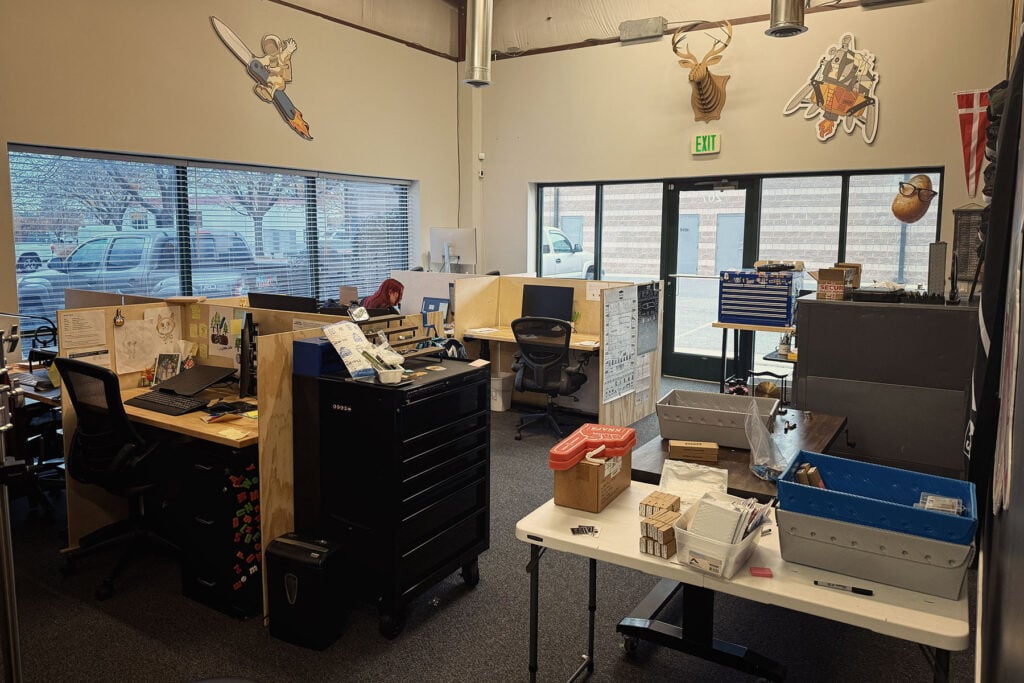
Maybe the most surprising thing about their entire place when was how little space they’ve been working with.
Their front office wasn’t much bigger than a two-bed hotel room, made all the smaller by a wall of large tool chests filled with prototypes, new and old. There are a half dozen or so computers separated by plywood partitions making short-walled cubicles. Everyone has their space, but it’s easy for any of them to lift a head and call over to someone else in the office.
Ben sits immediately to the right at his own computer as we enter. No walls around him. No private office. This is a place where all the workers communicate frequently, and (from what we saw) easily.
Walking in there wasn’t totally unlike walking into someone’s living room while they’re trying to get the house clean.
The Tour
Austin takes us around the shop. There isn’t much of the building to see, but there’s a lot to the business itself.
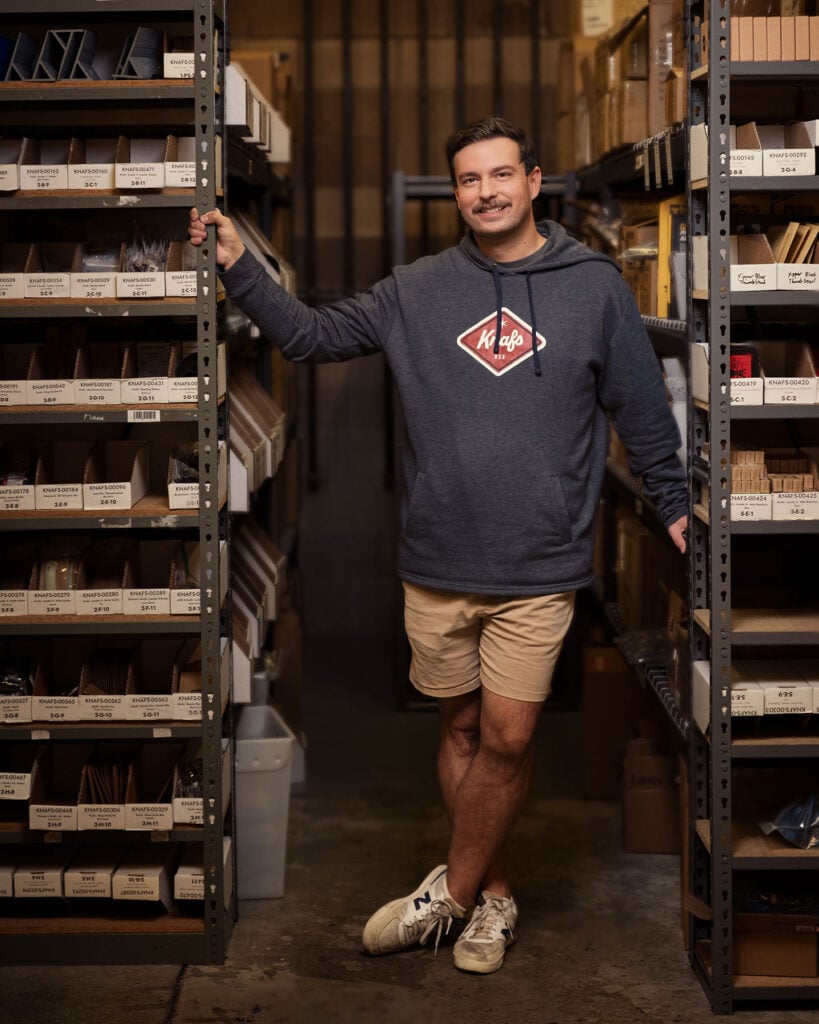
Knafs@NIte is shot in their front show room, which starts to feel crowded when more than three people are standing in it. Keith, of the Ship-Shape-Sharpening Shop works about ten feet from Matt W. in the most spacious area of the whole shop besides the half dozen rows of shelves filled with products ready to be packed and shipped.
As Austin leads us up a set of rolling stairs to a cramped, industrial looking loft where they shoot some of their content and product photos it dawns on us that the new warehouse they’re working on isn’t just a business expanding into new operations, it’s a lot of hard working people trying to get some breathing room.
It’s bigger than either garage Knafs was housed in before this, but for how quickly Knafs has been growing, and how hard they’ve been working, they haven’t had much elbow space to do it in.
The History: Knafs as a Rocket Ship
It’s something like a joke, because there’s a lot of talk about space with Knafs. Many of their folding designs pay homage to space programs that landed on the moon or Mars, and it seems like no Knafs drop is complete until a Space Kitty design appears for the handle scales.

A lot of crew at Knafs are fans of space and space-related activity. Petersen in particular finds the ingenuity required of humans to get into it is a good source of inspiration for not only making knives but trying to get a small knife company to keep going and succeed.
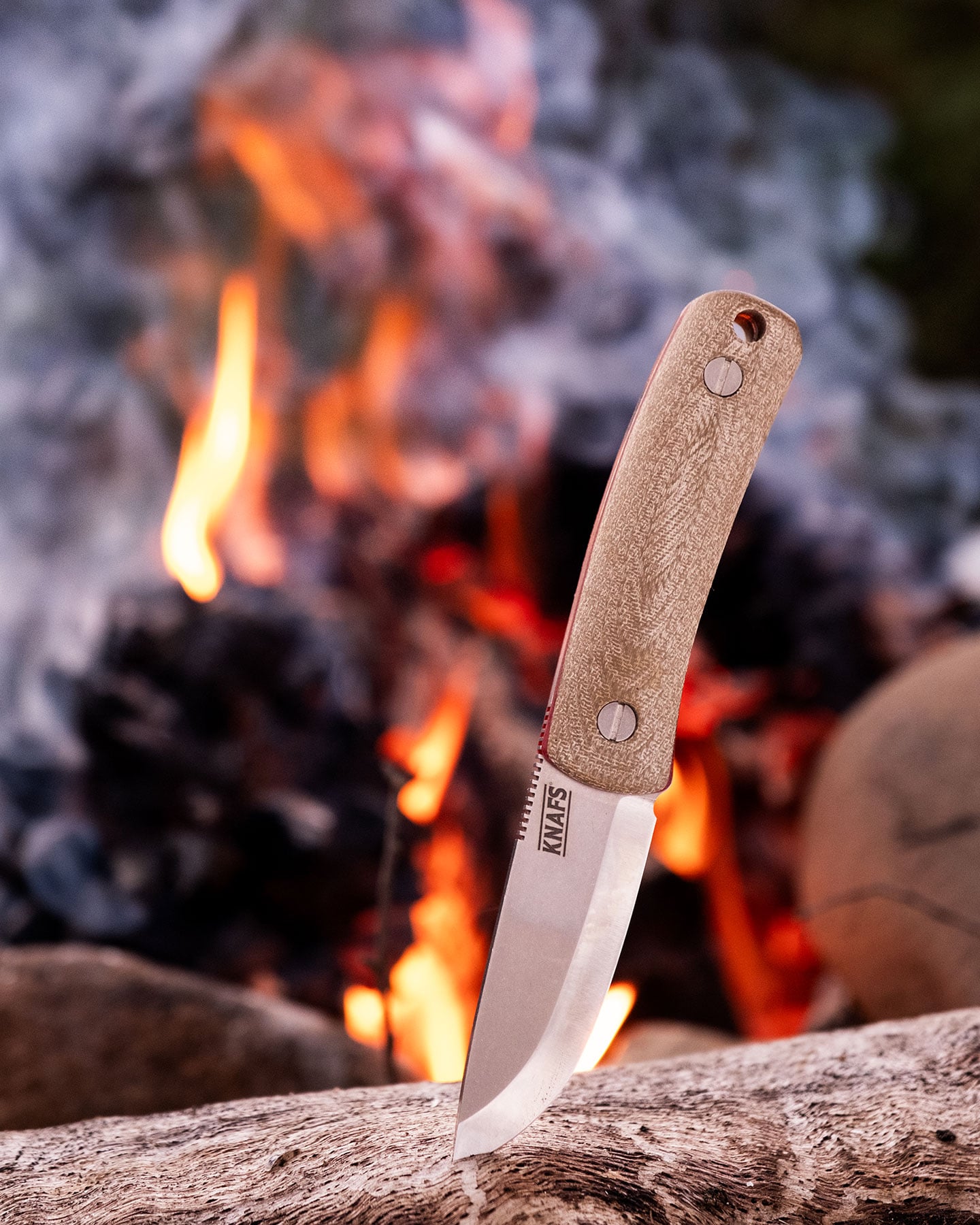
From the outside, it really has been like watching a rocket take off. Peterson and his wife, Athena, started the company just 6 years ago with a poster design.
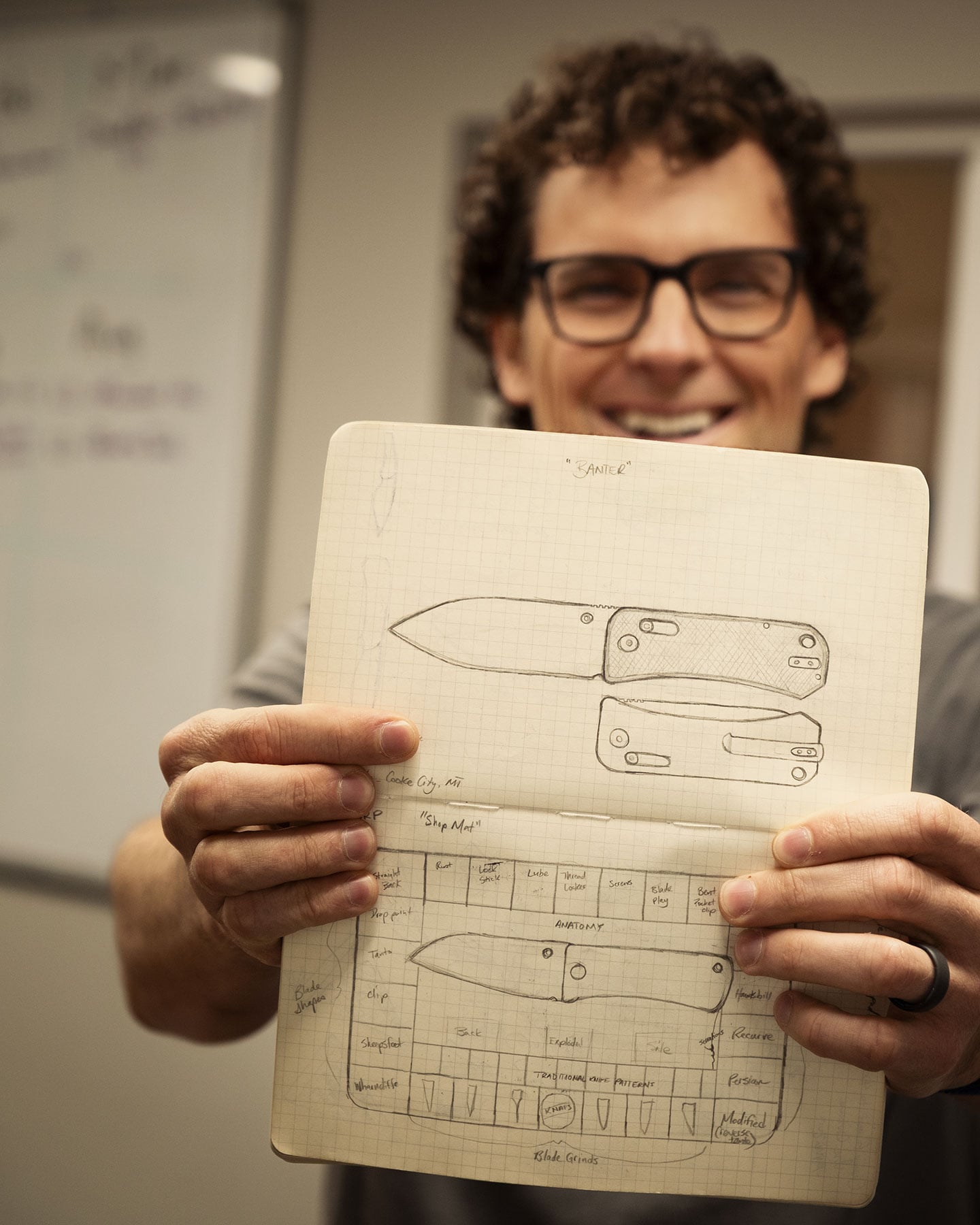
It’s been 5 years since the 2020 release of the Banter, the first official Knafs-branded knife design. In 2023 they moved from the garage into a warehouse, built a storefront into it, hired a few more people, and then it started to look like an exponential increase in speed. The next year they completed three new Kickstarter campaigns, and launched the Moon Crew Facebook group, and the Knafs@Nite YouTube channel. All of that was before they bought a new warehouse and a CNC machine.
But maybe like a real rocket launch, some of the majesty of the moment might be lost on the people inside the rocket, who are ever aware that a few wrong moves or a few pieces failing could mean an acute disruption to all their lives.
For what it’s worth, a few things have gone wrong for them, and they pulled through.
Early on, when it was just Ben and Athena, they had just launched their very first knife design, had already made the decision to put all the royalties back into the business, when they got a call about the Micarta scales for the new version of the Civivi Banter warping. Every single one.
That was a critical moment for Knafs. They were still running the business from home, and while they certainly had a large investment of time and resources into the business, it was still something they could have pulled out of, and the two of them could have begun rebuilding a normal life.
They chose to move forward, though. Made some adjustments and gave the green light for the countdown to continue, so to speak. Three years later they were moving the business out of their garage into their current shop, the Lander 1 had dropped and was doing well, and they had just launched their first US-made knife, the Lulu.
They were off to the moon.
Knafs Community Building
Maybe part of what has made Knafs so successful is that somehow we all feel like we were a part of that launch. Right from the beginning with the posters.
A lot of that has to do with the transparency of the company, but Peterson and his crew all seem to have a knack for building communities and making people feel welcome. In an industry where every company seems to focus on outfitting “dedicated campers”, “real soldiers”, “serious hunters”, Knafs keeps showing up with deviously simple designs and saying, in so many words, “this knife cuts good. Here’s a picture of a space cat you can put on it. You can also get a corn on the cob handle if you want”. That attitude has proved to be appealing for all kinds of people.
Between Knafs@Nite, the Moon Crew Facebook group, and the unprecedented level of transparency of the company (See: Ben’s Year in Review blogs I linked to earlier, and really any video they make), they’ve opened the gates of the hobby to a whole new crowd of people.
The best proof is probably in the fact that every time they want to release a new knife, they make it a Kickstarter campaign. In theory, if the campaign didn’t reach its goal, the knife wouldn’t go into production and they would move on, but every single one of their campaigns has met and exceeded its goal.
Some of that can be chalked up to marketing acumen. A lot of people in their office, including Ben and Austin, have marketing backgrounds that prepared them well for this journey.
But that acumen is driven by a genuine love of what they’re building. They relish the engagement from fans across all mediums and platforms. Their walls are plastered with drawings and haikus. Some from a special giveaway, others from people who visited their store front like us, and a lot from people who just send them things in the mail because they like the company and they’re excited to be a part of it in some way.
Now one of their problems is storage space. As we’re touring the shop, they’re anxiously waiting for their first full Lander 5 shipment. This is their most economic design to date, and in preparation from them being bought quickly in large quantities, they had made an order of ten thousand.
“We don’t really know where we’re gonna put them,” Austin tells us as we walk through their packed inventory shelves and into a more nebulously categorized space in the back that’s still cluttered with boxes from Blade Show.
This is another problem that will be greatly helped by the new warehouse.
Bantering with Austin and Matt Fitz
After the tour and a few pictures, Austin, ever the good host, starts chatting with me about where I’m from, but it doesn’t take long for the conversation to turn to knife design, and soon I find myself in between Austin and Matt Fitz as they pull prototypes out of drawers. Even the marathon of Blade Show West wasn’t enough to tire them out on this topic.
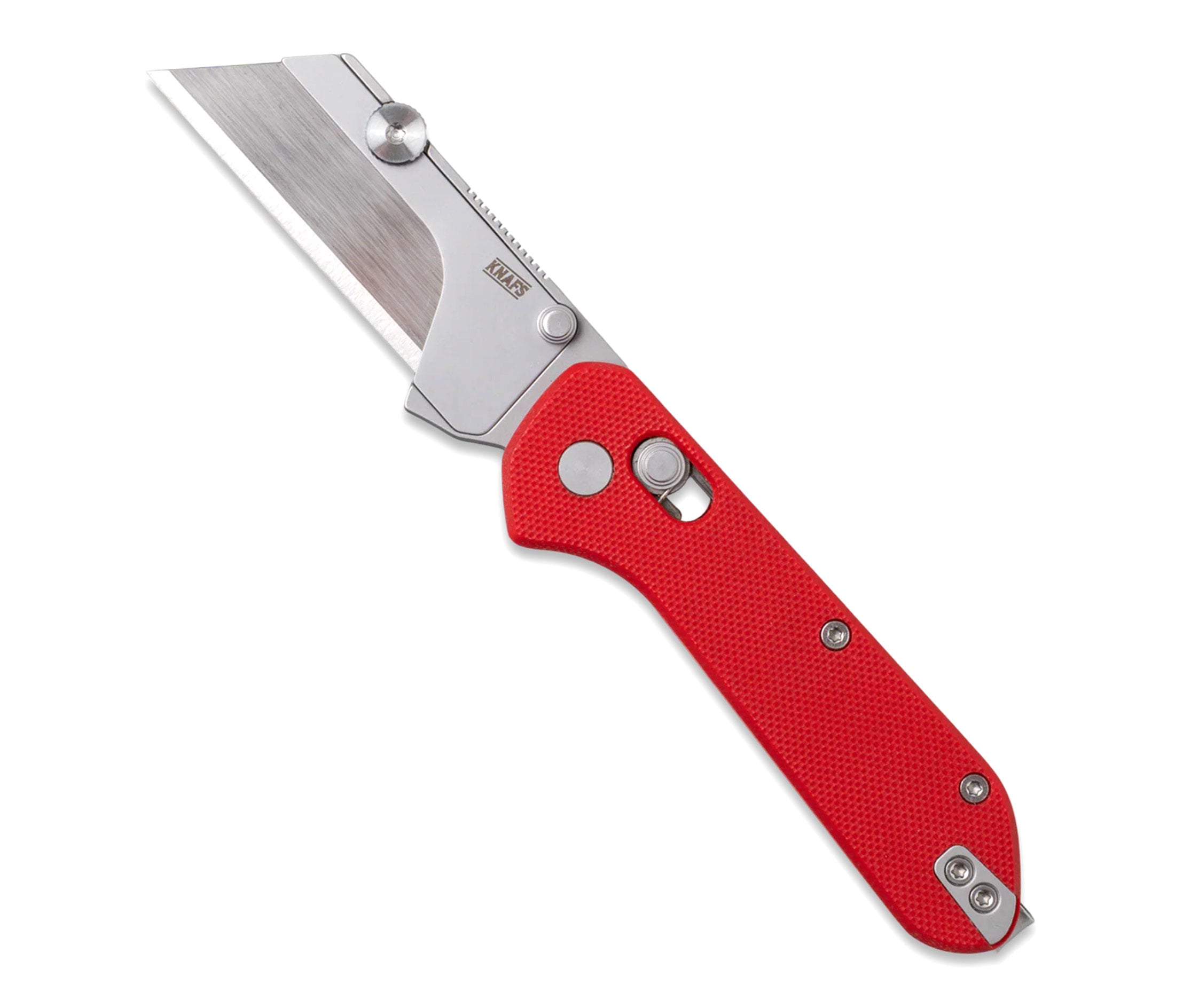
Matt takes out a (at the time) soon-to-be-announced folding utility knife (that has now been officially announced, and the Kickstarer for the Yuti is live right now).
I ask them something I thought was innocuous about the handle and it immediately instigates a discussion between the two about design language as they go over little details of the knife, talking about what makes it stand out or what seems similar to their other knives. It doesn’t take much to get them going like this.
It’s easy to imagine this scene happening often in this office. Everyone is hard at work trying to keep the place running smoothly, but it’s full of people who not only like knives but love making things that are really, truly good and useful.
Bitter Sweet Progress
Finally I ask, somewhat leadingly, if they thought this process of brainstorming and workshopping designs will be smoother once the warehouse was fully equipped.
A resounding, nodding ‘yes’ from both of them. They’ll have control of more of the process, they’ll be able to produce prototypes and adjust details faster.
Then I asked about the size, wondering about capacity. I wanted to know what would actually go in there. How much of this would they be able to do on their own? They told me that sharpening, engraving, and assembly would all move to the new warehouse. That would be great, because it would leave more storage room.
Then I said something that maybe I shouldn’t have: “Oh no,” I joked. “You’re breaking up the family.”
Again, they both nodded. This time much more soberly. They’ve already talked about this, it turns out.
“We love having Keith around,” Austin says as he gestures back toward the Ship Shape Sharpening Shop. “He’s great.”
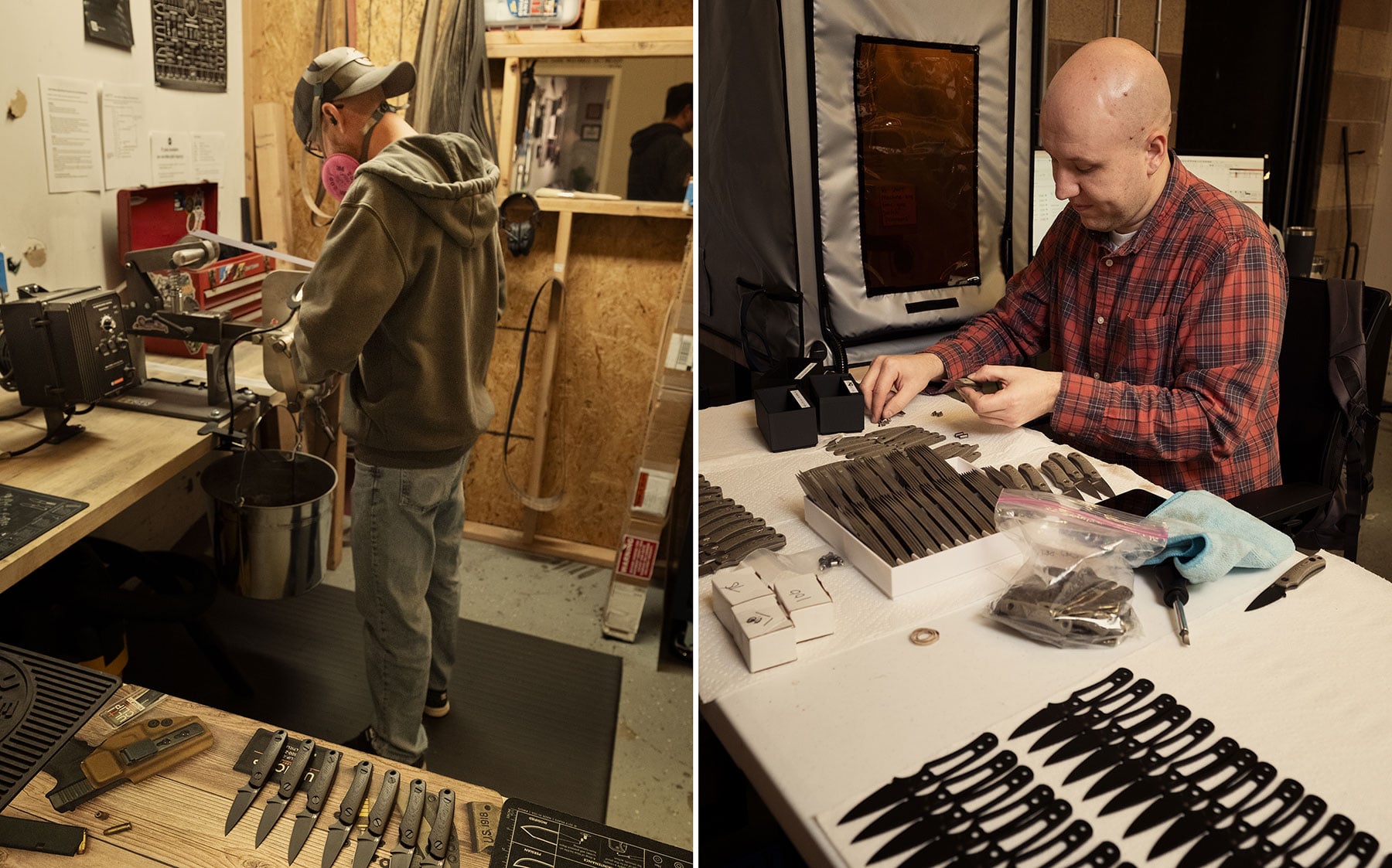
That’s when I realized saying the family splitting up wasn’t totally a joke. That’s really how it will feel to them. Not in a divorce kind of a way. It’s like siblings moving into their own house, but it’s still a physical separation.
So this is a bittersweet time. They’re all clearly excited about expanding. They’ll be more capable as a business when the warehouse is done. They’ll have more storage, they’ll be making more of their own products, and they’ll (hopefully) be positioned to keep expanding that side of Knafs. They’ll be that much closer to becoming an established American-made knife company, maybe not too unlike Kershaw or even Buck.
But that growth will come with the loss of some intimacy. It’s not a bad thing. This is what businesses do when they’re run well. They expand and diversify. And it’s a great thing for knife hobbyists like us, because even with the growth, Knafs will still be Knafs, and these are exactly the kind of people we like to see putting more of their vision into the world.
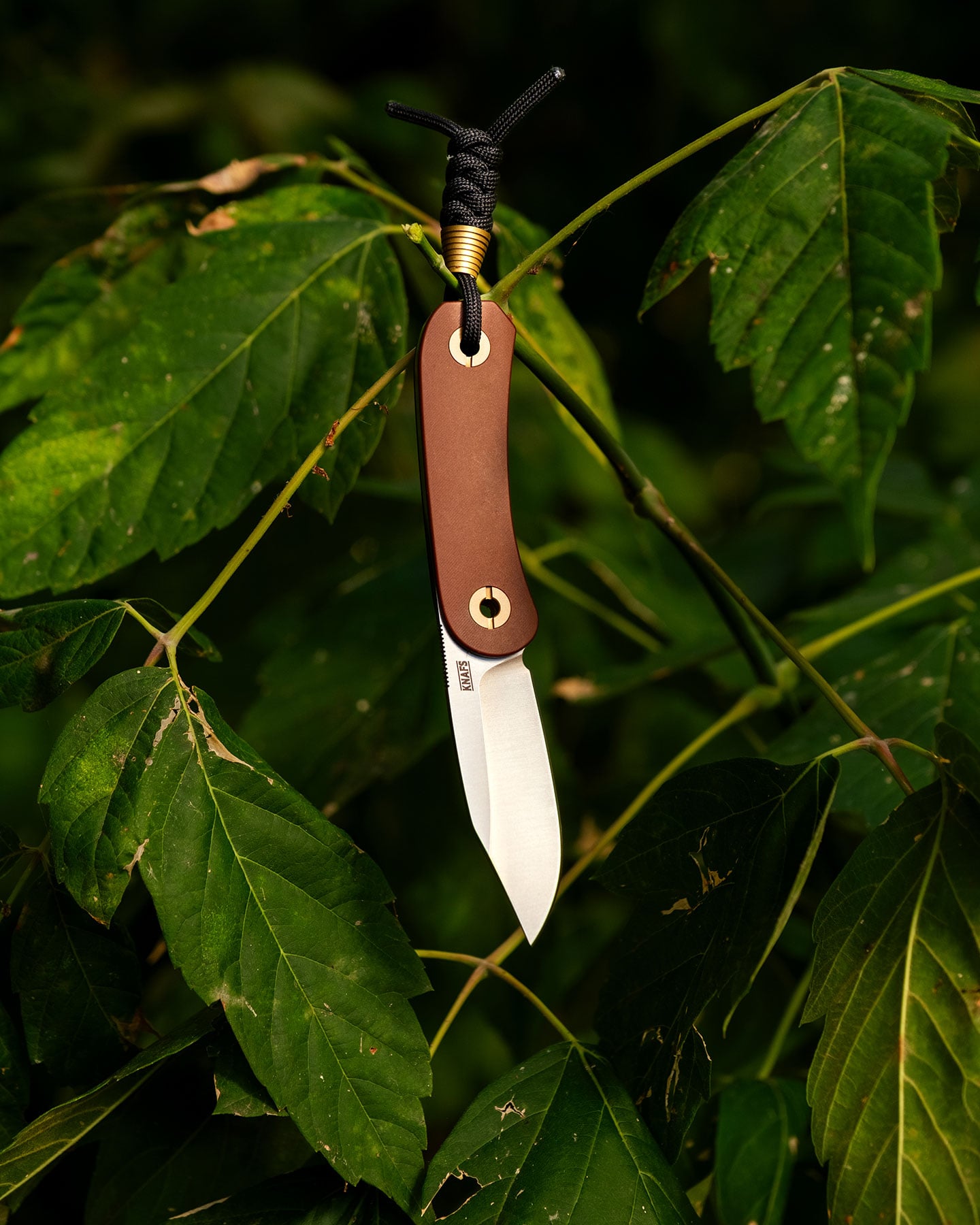
We left with the impression that they’re transitioning from a scrappier time they’ll remember fondly. A time when they all shared a building and could call across to each other any time they needed something.
Some of this is hyperbole. They’ll all still be working in the same company, seeing and talking to each other. But things are about to be less cozy for the Knafs family. The rocket is landing, and they’re about to step out onto the surface of another world, and we all get to watch from home, hopefully cheering them on as they kick up another Space Kitty scale design for us to print.