
Key Takeaways:
- The funny looking Fibonacci grind really does make this knife better for carving wood.
- It’s great at batoning too, and good for rough food prep.
- The sheath was well designed and well made so the Arbor rides and draws comfortably.
- Down sides for me were that the handle is too smooth and it’s a high price for general recommendation.
- Also the way the tang sticks out in a border around the handle scales makes it tricky for cold weather (it’s still super comfortable, though).
This Smooth Carver from Olive Knives Tests the Edge of How Complex a Bushcraft Knife Should Be
The Olive Arbor is by far the fanciest bushcraft knife I’ve ever used, which isn’t a word I feel like I should be using on a bushcraft knife, but here we are. It also an expensive knife and we got it for free for review, so I went into testing it with an urge to find as much wrong with it as I reasonably could. That turned out to be incredibly difficult.
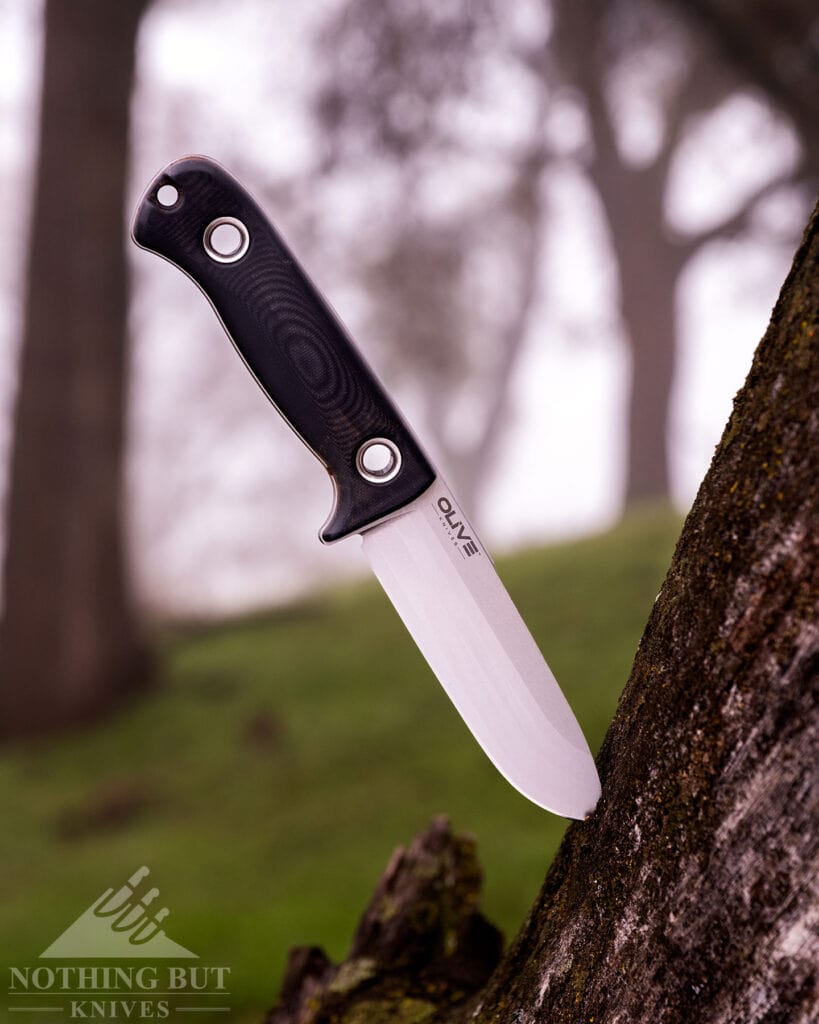
Besides being one of the smoothest wood carvers and most comfortable handles I’ve felt since Reiff knives hit the scene, I keep finding little details beyond the wild blade grind that show this knife has been carefully thought through:
- The handle is shaped so it just hugs the index finger and the pinky in a gorilla grip;
- They crowned about an inch of the spine so the thumb has a comfy resting spot, but ground the rest to a hard angle so it throws spark;
- The retention screw in the sheath has a rubber barrel spacer in the middle that doubles as a thumb ramp;
- In the vertical position the pommel rides just about the belt line;
- The holes in the sheath are spaced so you can adjust how high it rides in small increments,
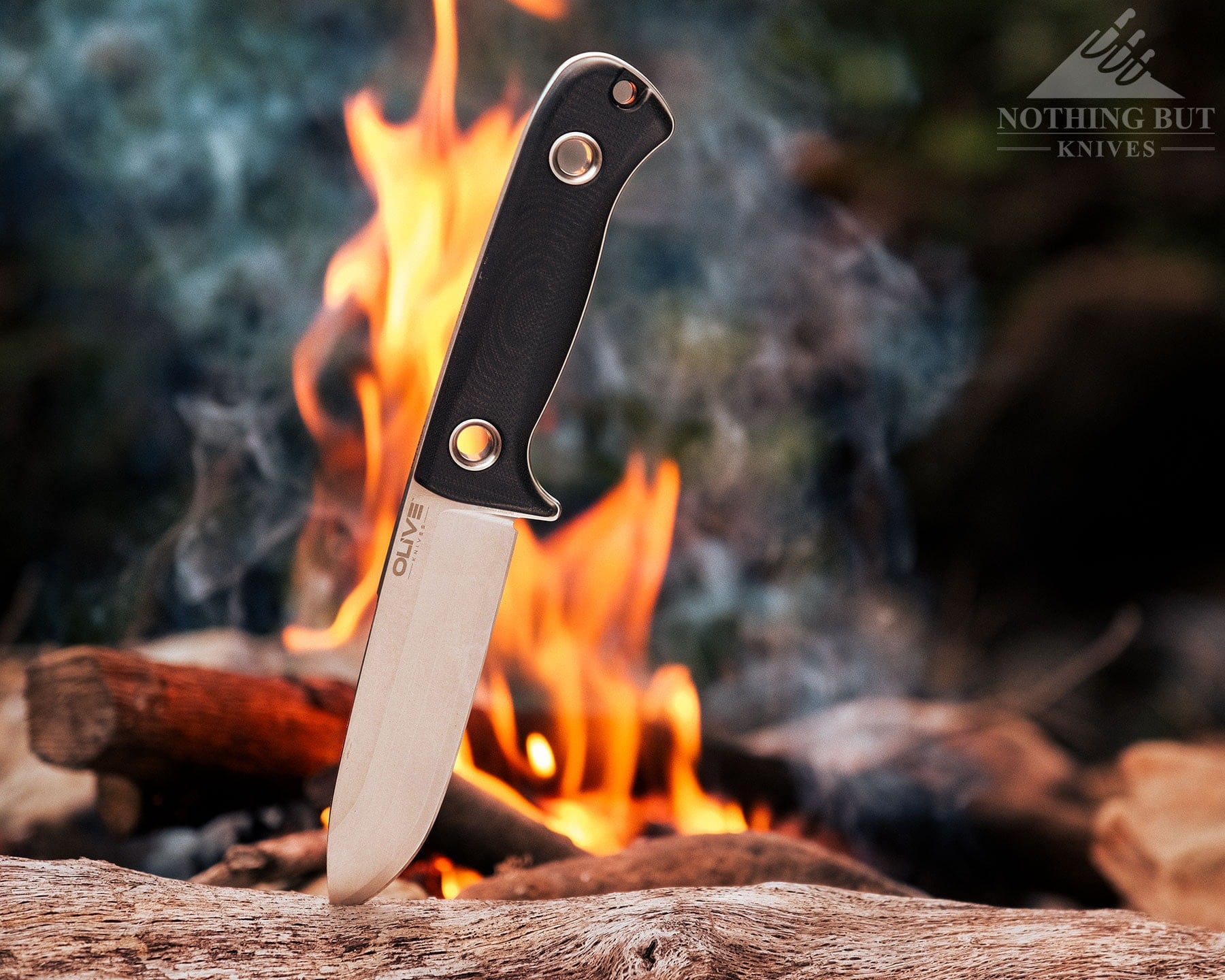
Probably the worst criticisms I could level at the Arbor is that the texture of the handle scales are too smooth for my liking, the grind complexity could make long term maintenance tricky, and it’s just an expensive knife to recommend to anyone.
But it was made to be a high performance bushcraft knife, and Olive Knives hit the mark dead on.
Specifications
| Overall Length: | 9.2716” |
| Blade Length: | 4.54” |
| Blade Steel: | Elmax |
| Hardness: | 60 – 61.5 HRc |
| Blade Thickness: | 4.5 mm |
| Blade Shape: | Drop point |
| Blade Grind: | Fibonacci |
| Handle Length: | 4.73” |
| Handle Material: | G10 |
| Weight: | 9.175 oz (12 oz w/ sheath) |
| Made in: | USA |
| What I Liked | What I Didn’t Like |
|---|---|
| Yeah, this grind is great for carving | The price, of course, is prohibitive |
| Great edge retention despite thickness | Handle texture is pretty smooth |
| A lot of good sheath details make it nicer to draw and carry | Elmax in a crazy grind probably won’t be fun to sharpen |
Cutting with Math (or the Fusion of Flat and Convex Grinds)
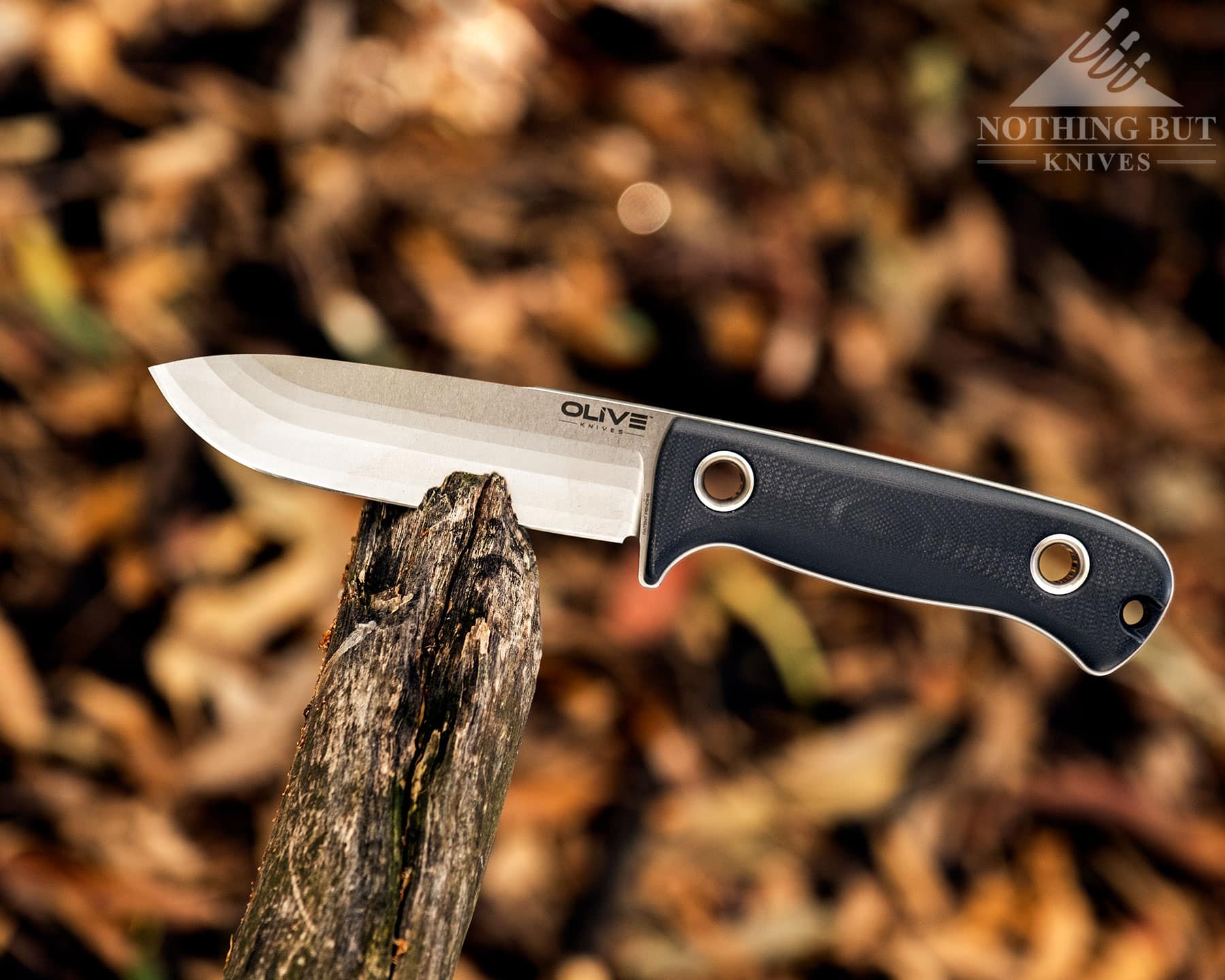
Let’s get up on this elephant: what’s up with the Fibonacci grind?
The idea behind it is to combine the benefits of a convex grind and a flat grind.
Convex grinds are really good for giving users a lighter touch when carving wood (it’s easier to make thinner shavings) and tearing up wood because the thickness behind the edge usually splits and chips pieces faster. Flat grinds have better cutting edges because there’s less material direction behind the cutting edge.
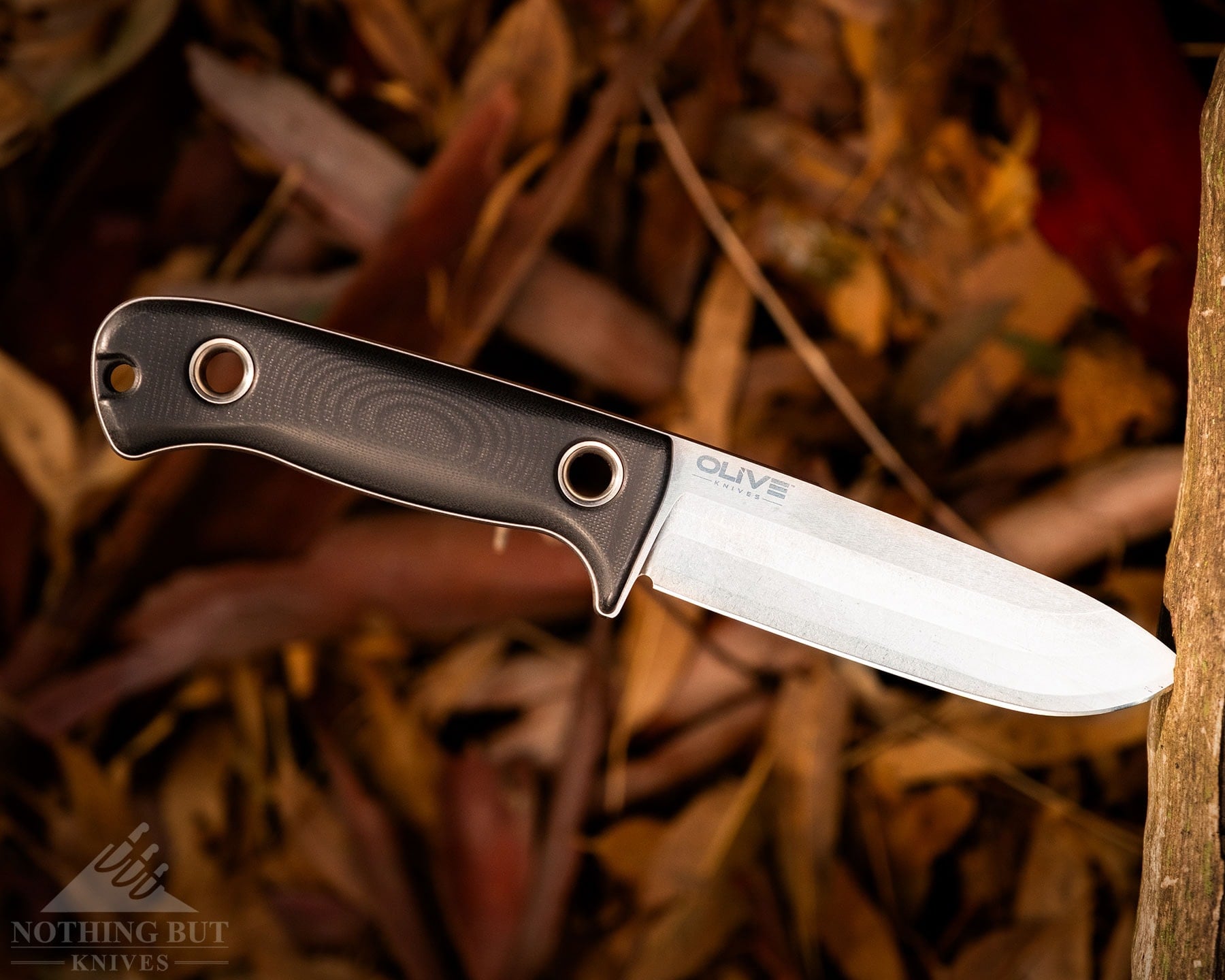
By stacking a bunch of shorter flat grinds on top of each other in increasingly widening angles so the overall line of the forms a stepped version of a convex shape you might get a bit of both worlds.
The Fibonacci grind seems to actually seems to accomplish this: It has something of the soft touch of a convex grind in that it feels like having guard rails around the edge that keep it from digging too deep, but there’s still a certain level of aggressiveness that can bite hard into tougher materials and makes starting cuts easier.
Time on the Honing Rod
So far, edge maintenance hasn’t been too bad. I feared the worst when it came to maintaining or fixing the edge. This is hard Elmax steel with a weird grind. Nothing about it looks easy to me.
It was a while before I got to find out. The blade took a lot of beatings before any deformation appeared, and it ended up being a couple of modest rolling in the edge. Those ended up taking a little more time than usual to straighten out on a ceramic honing rod. I didn’t count individual passes, but I probably did three sets for each side of the blade before I was satisfied with how it cut.
I dread the day this chips or is just used to the point of needing a proper sharpening session. I’m not sure exactly how thinning a flat grind into another flat grind is going to look. That day seems far away, though. We’ve put it through a lot of abuse, and the typical damage I see after each trip into the woods was minor rolling, and the grind actually seems to help me find the right angle.
A Classically Good Handle

There’s nothing especially striking or original about the handle. It’s just solidly good. There’s absolutely nothing wrong with that. This is a shape that works. It’s super comfortable, has a nice grip, and mostly stays in the hand.
There’s some subtle curvature here that fits into the wells of my hand really well and keeps the grip solid despite the smooth texture of the scales.

It’s the kind of handle you forget about when you’re working. There are no hotspots, there’s no weird shaping that feels awkward in a full or pinch grip, and it doesn’t irritate the hand when I’m chopping (it does like to slip out of the hand while chopping, though).
Soft Core Steel Exposure
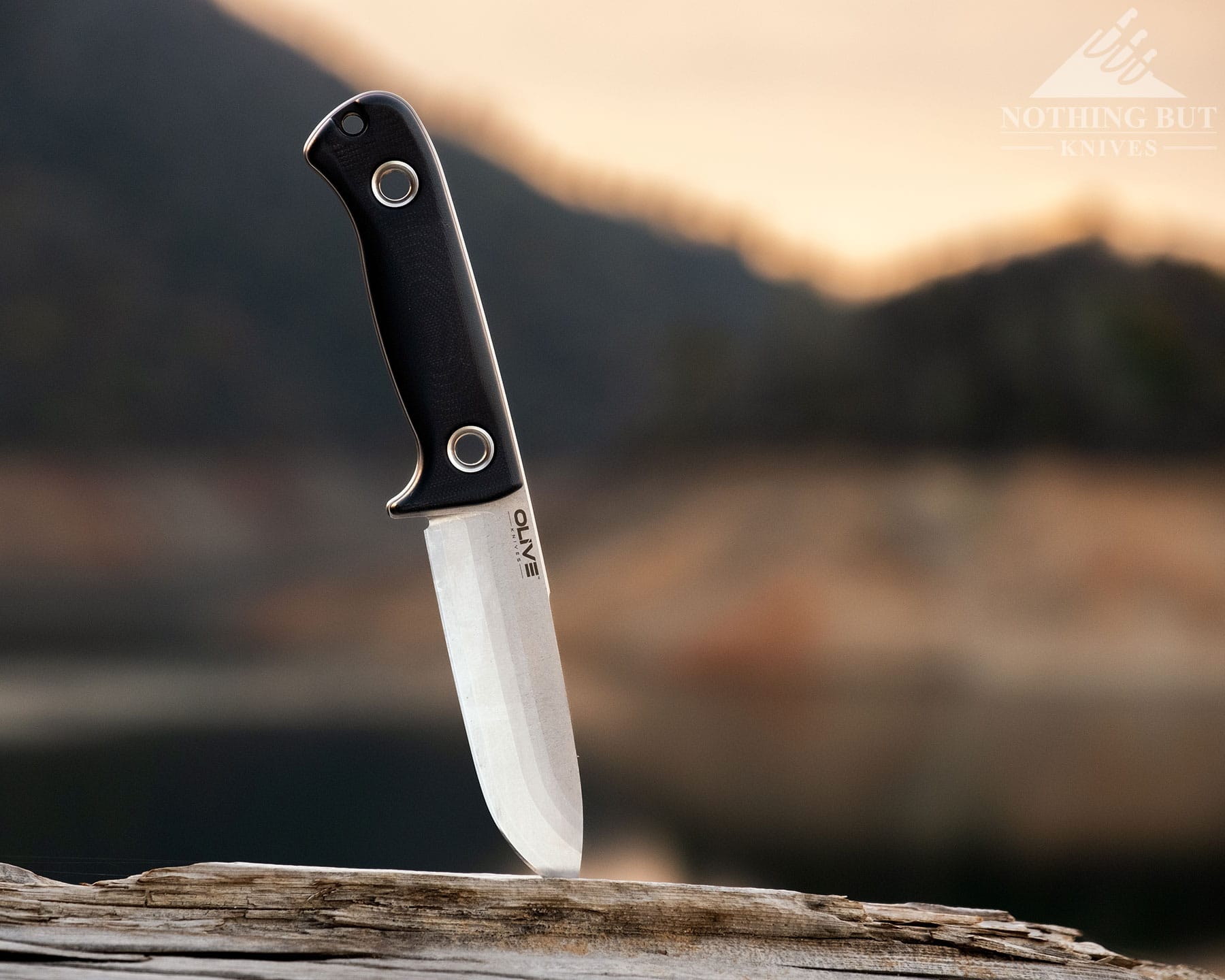
The only thing that makes the handle stand out when I pick it up is the exposed tang, which bulges just a little outside the line of the handle scales. They were clever about doing this. The tang is crowned so it’s still comfortable, and even helps add some extra dimension to the grip.
It’s still exposed and protruding steel, and that can be less than pleasant in bitterly cold weather. I haven’t tested it at freezing temperatures, and it might not be my first choice if I were planning that kind of trip. As it was, the handle gave my skin a little bit fo a shock when I grabbed in the dead of winter.
It’s one of those things that could be a non-issue, since most people in freezing environments will probably be wearing gloves anyway, but I feel like it warrants a mention on a knife that’s so capable outdoors. Exposed steel in freezing temperatures is brutal to handle.
The Sheath Gets a Lot Right

I want other makers of knives with larger finger guards to take careful note of how this sheath has been made, because I want to see more of this (the Reiff Vicon, for example, would benefit from this):
They’ve left the top of the sheath where it covers and interacts with the bolster open so it’s two springy flaps. These flaps are held and adjusted by the retention screw. This allows for a more granular adjustment range on the sheath’s tightness.
The rest is good too. It’s pancake Kydex with a drain hole. It rides vertically with a nylon strap, and the backing it’s attached to can be adjusted in pretty small increments in case you want it to ride higher for some reason. The Arbor’s lowest ride height is just about perfect to me, though.
The Arbor In Use
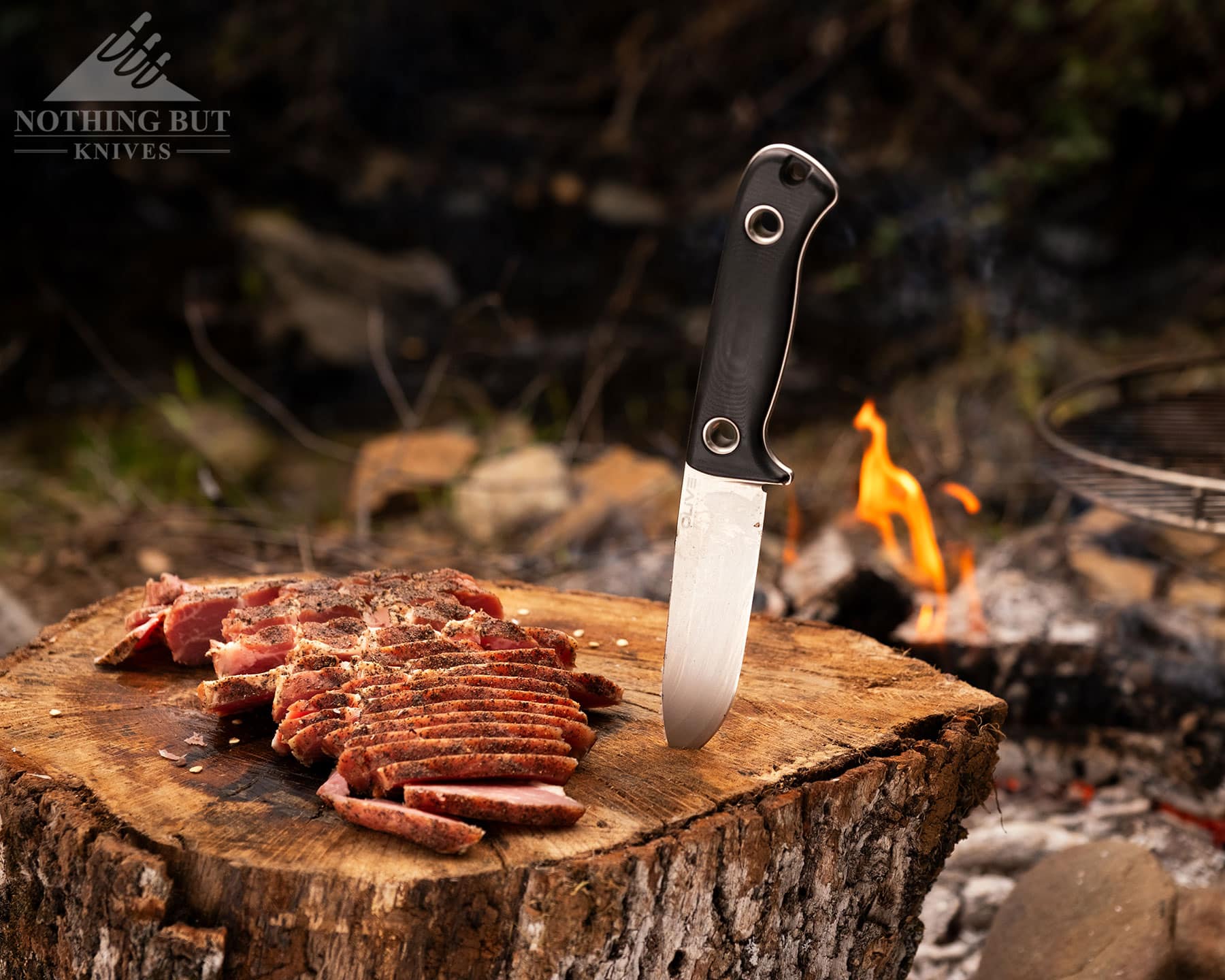
Just to make sure you get a clear picture of how all these elements come together, here’s how things went with the tasks we used the Arbor on the most:
Chopping
The grind has a little bit of an axe quality in that it bites hard into wood but the edge is wide enough that it breaks up the surface easily rather than sinking in and getting stuck. This is where the smooth handle stops working for me, though. I had to readjust my grip every few swings to make sure the knife didn’t flow out of my hand.
Batoning
This is maybe the only knife that ever felt smooth to me while batoning. I’ve used knives that were fast, or brutally efficient, or gummy. But never smooth.

Even on oak logs it hammers down easy. The funny thing was that (at least with the batch of logs I was working with) it didn’t fully split the logs until it was over halfway through, which throws off my metrics for judging this task: Typically I call a knife great for batoning with a log splits enough to pull apart after a few swings. But with the Arbor it felt so easy to hit it down that going two-thirds through a log didn’t feel like putting it much more effort. So it’s good for batoning, just in a weird way.
Feather Sticks
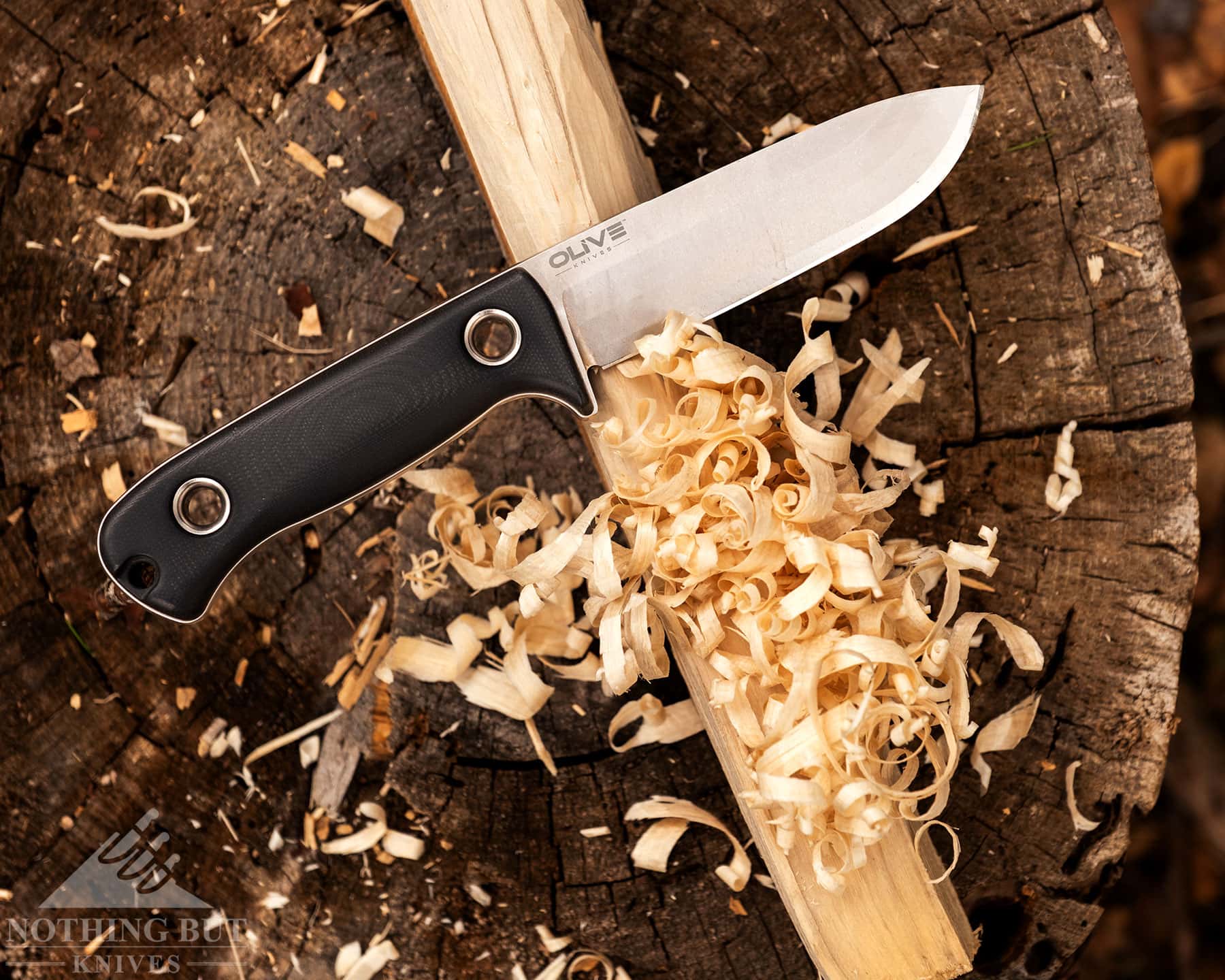
The Arbor is by far the gentlest carver I can remember using. It cuts smoothly and all the grind steppes going up the blade help find the right angle, keep it consistent, and control the strength of the cut. Carving in general actually makes we wonder if eventually sharpening the blade will be easier than I think just because the shape makes it easier to make subtle angle adjustments.
Throwing Spark
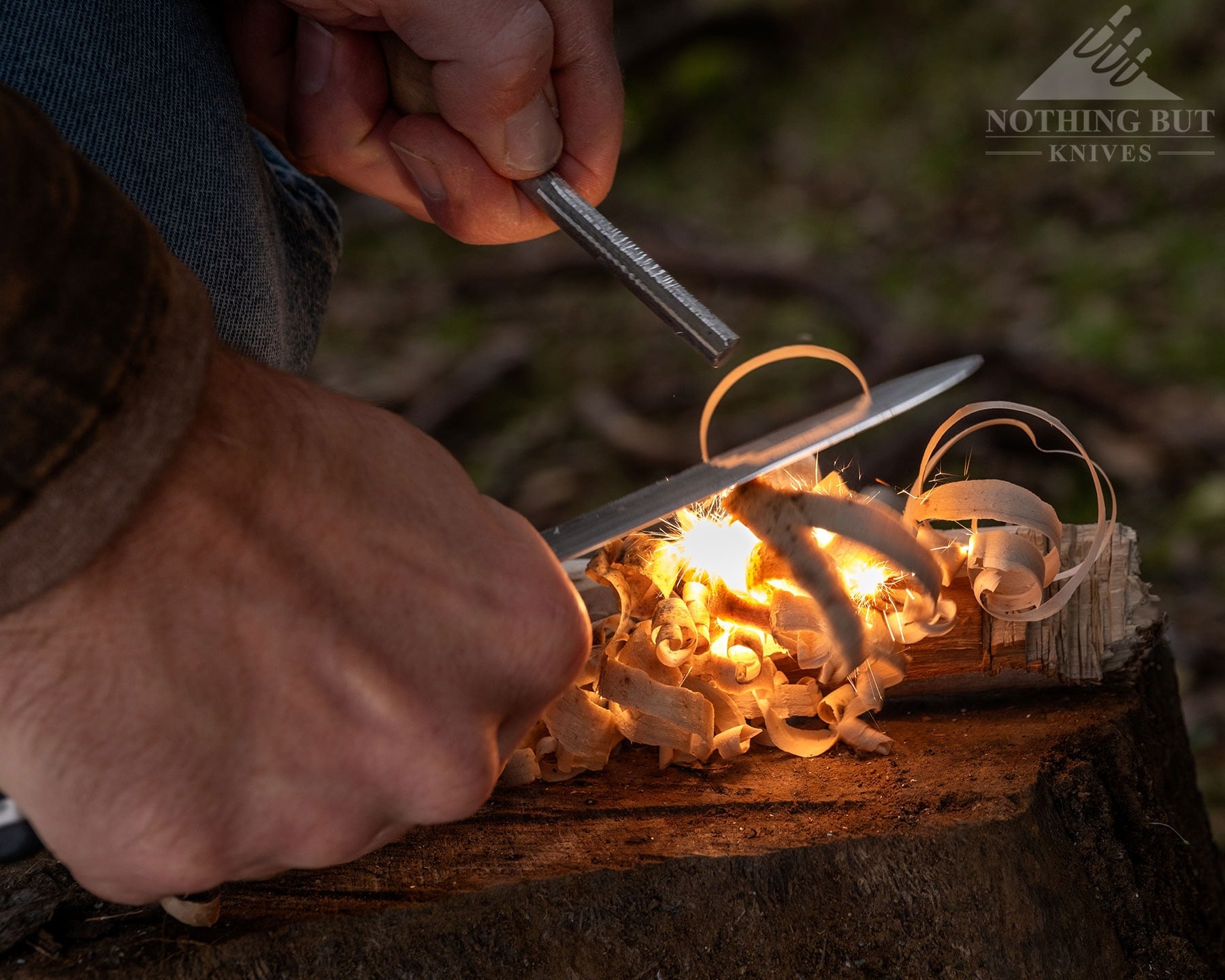
Pretty effortless. The part of the spine that they left at a hard 90° lights up with a ferro rod easy as anything. The only problem was sometimes my hand would slip over and run the ferro over the crowned section of the spine, but that’s just an issue of technique.
Food Prep

I expected the worst performance from the knife here because it’s so thick, but I think that actually helps. The edge is so sharp that it’s easy to cut into just about any kind of food, then the width behind the edge pushes the food trimmings away so they don’t stick to the blade. That’s especially helpful with mushrooms, which have a tendency to build up ono the side of a blade and fall all over the place.

The cuts still come out pretty rustic, but for campfire cooking, the Arbor did a great job.
Breaking Down Boxes
It slows down a lot cutting through cardboard. The expert sharpening done by Olive helps it along a lot, but there’s still a stronger feeling of resistance when I cut through anything softer than wood and longer than finger width. This wasn’t much of a surprise, though. You can sharpen and finish this knife all you want, it’s still a thick blade with a lot going on behind the edge.
The blade thickness is necessary for the hard-use type tasks this knife was designed to handle, and the Arbor’s impressive overall blade performance is a big part of why we consider it one of our favorite bushcraft fixed blades.
Comparison and Alternatives

If you can find it in stock, the scandi-grind version of the DBK Bushfriend 2000 is a pure bushcraft knife that eats through wood on an easier budget. As a scandi grind it’s a little more prone to chipping, but it holds up better than your average scandi edge. The handle is also too smooth for my tastes, but that was also a design decision on the part of the DBK boys to reduce friction, so what do I really know?
Either the Reiff F4 or the F5 are good alternatives if you like a well done dry Micarta texture and want a handle that’s designed more specifically with wood processing in mind. The upside-down Coke-bottle shape is great for carving, and they usually run a little cheaper. But I actually like that handle shape a lot less for chopping.
For something more general-purpose, I can’t seem to stop recommending the Schwarz Knives Lost Trail 5. It’s one of the best chopping and batoning knives I’ve ever used, and the Richlite handle feels as good as any grippy Micarta scales. It’s also much cheaper (usually somewhere over $200). The caveat is the blade is made of non-stainless A2 steel, and it’s not as specialized for carving.
It Looks Like a Lot, but It Works
The Olive Knives Arbor is a Volvo. It seems needlessly complicated, but all the crazy details add to making this a better tool for the user. The main reason I wouldn’t recommend the Arbor to someone (beside the price) is if they’re the type to be intimidated by sharpening.
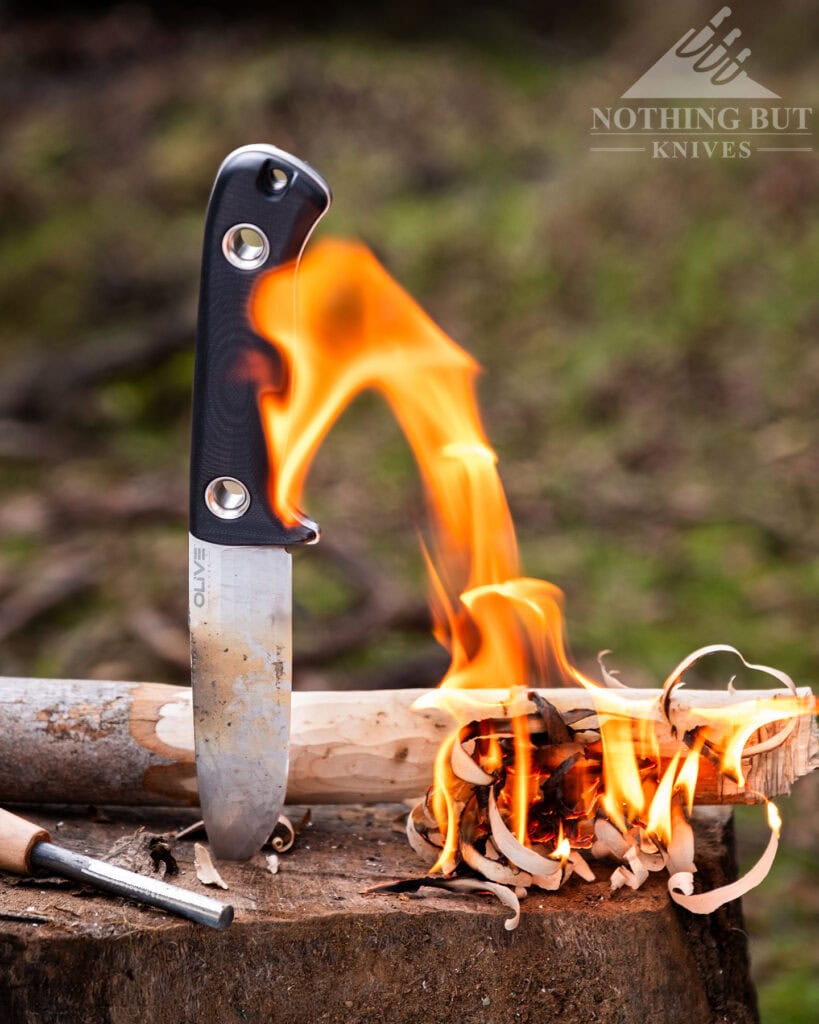
Is it still more detail than anyone really needs on a good bushcraft knife? Yeah, of course. We all walk in the shadow of the Mora Basic 511 when we talk about knives like this.
Is it too much, though?
Maybe. But this is a legacy knife. It lasts, and if you’re going on more than one camping trip a year, the experience is worth the price tag (assuming you can afford it in the first place).
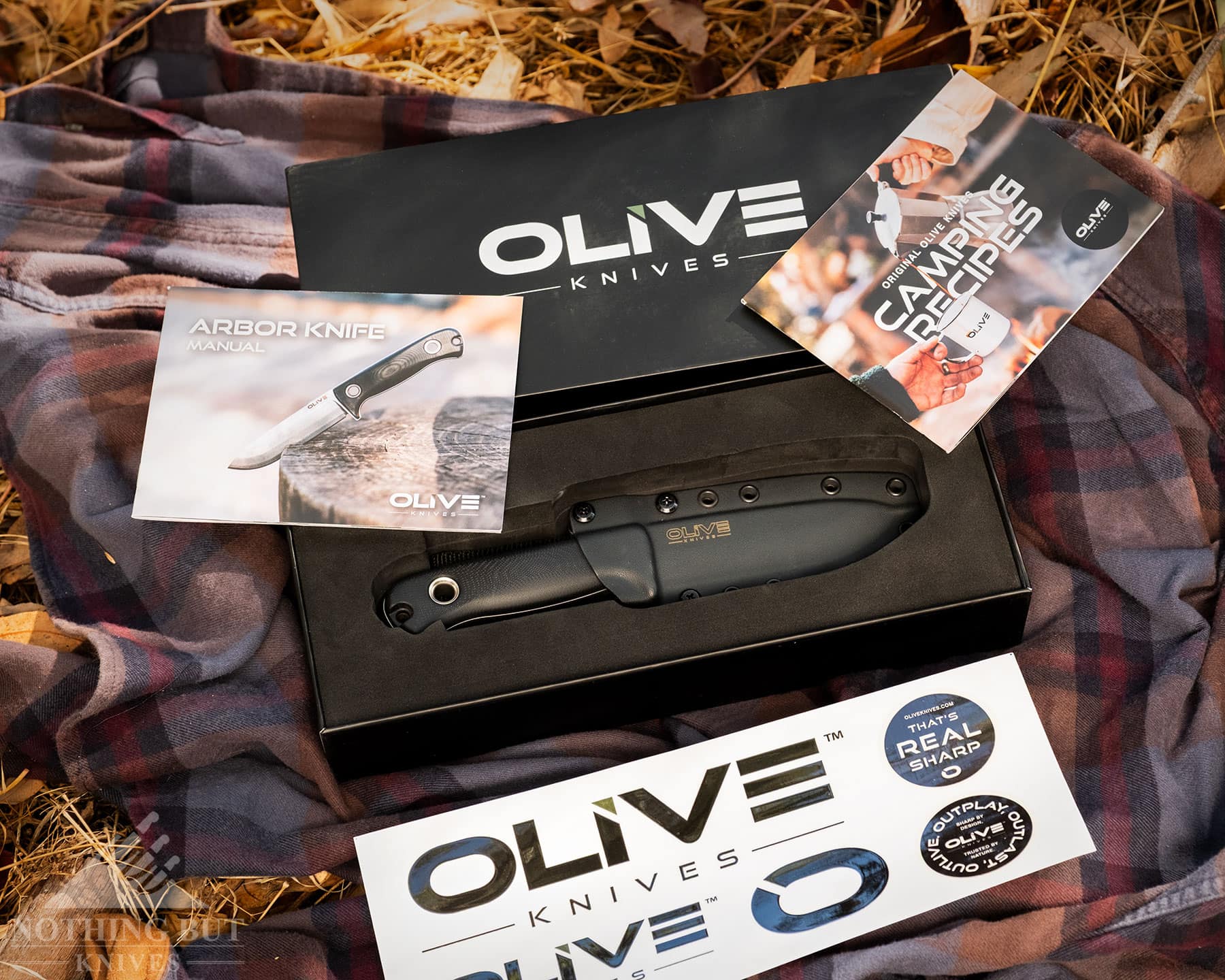
The sticking points here for me are the price and the eventual difficulty in sharpening the knife, with an extra little warning about the protruding tang in freezing weather.
I’m inclined to give Olive Knives a pass on the price. You don’t go out to buy a sports car and act surprised when it costs half a million dollars. And if it ends up being tricky to work on, maybe that’s just part of the experience you buy into because you want to use something that looks cool and rides smooth.
Olive set out to make the best knife they could, no expense spared, and they did it really well.


I’ve been waiting on this review to drop. You pretty much confirmed my expectations: an extremely well made, high-performance knife with centerfold photogenic qualities. And it better be for the price.
Speaking of price tags, over the last couple of years I’ve only been using and gifting knives that are easy to replace. Albeit, still well made and yet easy on the eye and bank account. So, whether they are lost, stolen, or confiscated, you don’t cry yourself to sleep at night over the loss. In saying that, for this all-purpose out-of-doors knife category, the Cold Steel Master Hunter in 3V has been the poster child for my outdoor, fixed blade knife of choice. And as a side note, my all-purpose EDC folder has been the CS Large Voyager with a 4″ drop point blade for all the same reasons stated.
Great rundown on this bad boy. Wishing y’all a Merry Christmas and a happy and prosperous 2026!
These days it’s really hard to say whether any knife that costs more than $200 is worth the price, especially when there are old heavy hitters like your Cold Steels still around. But the Arbor at least feels like you’re using a $400 knife in just about every way you’d want it to.
Thanks for reading as always, Jaime.