This Ended Up Being a Decent Hybrid Japanese Knife for the Price; It Just Feels Weird.
It has a nice blade with a crisp edge that’s great at cutting lighter vegetables, feels reasonably comfortable, and has a nice look.
This review would have a different tone if it were even $30 more expensive, but taken within the broader context of big-name kitchen knives it gets you decent performance at a mid-range price.
All that said, I don’t personally like it. I have ergonomic issues with the way the’ve blended elements from German and Japanese cutlery, because it either makes my push cuts feel weird because of the big belly, or makes my rock chops feel awkward because the blade isn’t tall enough.
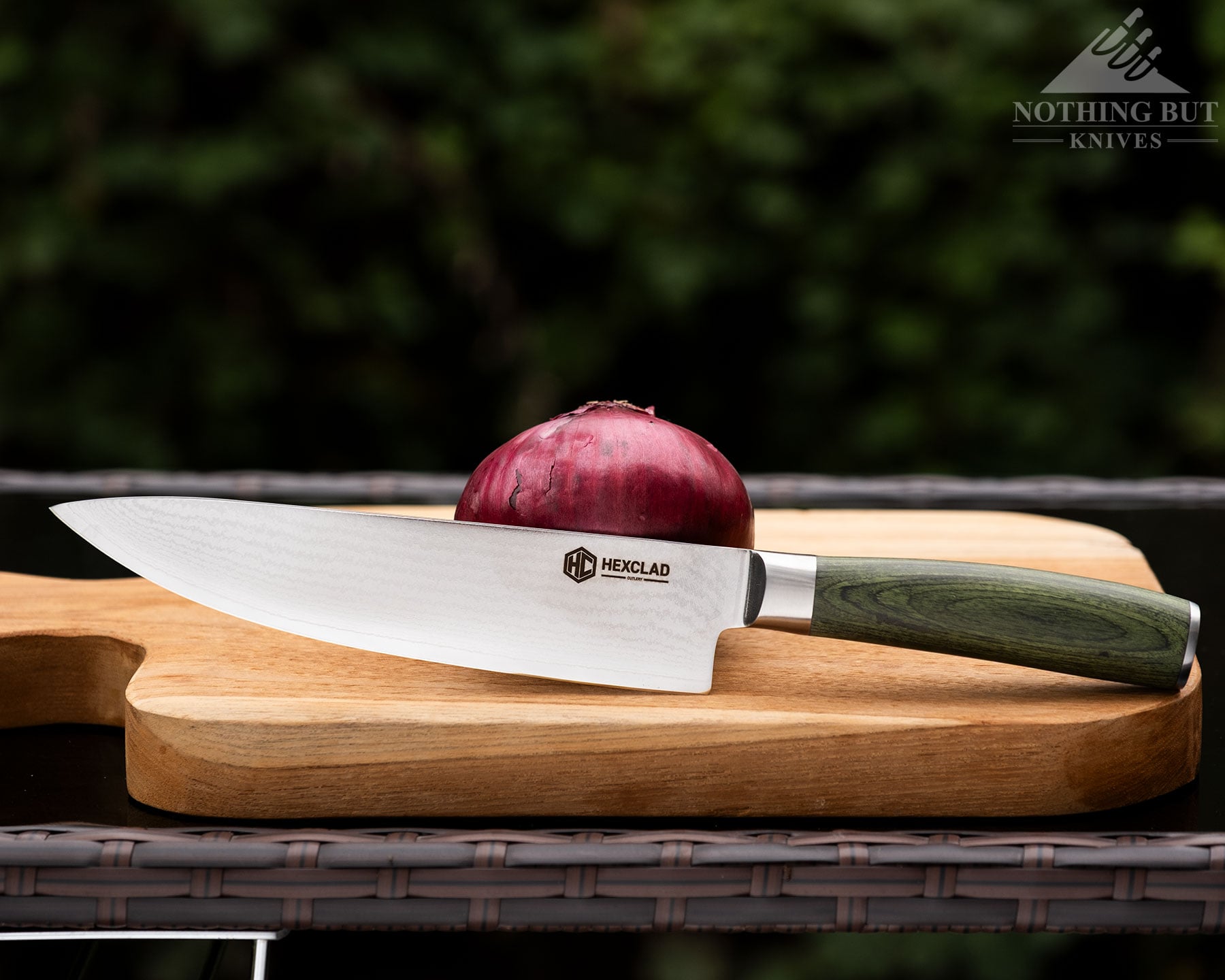
I can appreciate the concept and the execution, though. It’s a well-made knife and it’s still pretty difficult to find a decent Damascus blade at a mid-range price like this.
Specifications
| Overall Length: | 13.0” |
| Blade Length: | 7.5” |
| Blade Steel: | 67-layer Damascus w/ AUS10 steel |
| Hardness: | 60 – 61 HRc |
| Blade Thickness: | 2 mm |
| Blade Shape: | Western |
| Blade Grind: | Full flat |
| Handle Length: | 5” (about 0.5” ricasso) |
| Handle Material: | Pakkawood |
| Handle Type: | Rounded |
| Weight: | 204 g (7.2 oz) |
| Made in: | China |
| What I Liked | What I Didn’t Like |
|---|---|
| Thin edge has a nice bite | The spine bites into the finger |
| Lightweight | The weight and balance feel awkward for rock chopping |
| Good price for the fit, finish, and performance | The Japanese and German elements just aren’t blended that well. |
The As Seen On TV Effect
Incoming rant about celebrity endorsements. Feel free to skip down to the functional stuff:
I started testing this knife with a lot of skepticism. From afar it seems gimmicky, and they put a lot of attention on the fact that this is mostly a German-style knife but made with Japanese steel and sharpened using the Honbazuke method, which is not as unique in the kitchen knife world as their advertising might lead you to believe.
Plus these are Chinese made knives and they have a big-name celebrity endorsement. That first thing isn’t the red flag it used to be. Chinese manufacturing has come a long way in the world of knives. The second is what really caught me up.
It’s not even the fact that they’re using a celebrity. A lot of knife companies are desperately trying to leverage influencers to get on anybody’s radar in an industry that has never been more saturated in human history. Getting Gordon Ramsey to hold their knives while looking sternly at the camera is an understandable marketing move.
But ask just about any knife maker or sharpener the world over, and they will probably tell you that most chefs don’t know a damn thing about knives.
To make it worse, Hexclad is a kitchenware company, not a cutlery company. Knives are a small percentage of what they make. I became graphically aware of that fact while sitting down to watch yet another chef competition show hosted by Ramsey where the prize was some five-figure number and a pile of Hexclad pots and pans. Every contestant was wearing an apron with the Hexclad logo front and center, and you better believe they filled up the space of every episode with as many close-up shots of the Hexclad equipment provided as they could reasonably get away with while still leaving us with the impression that we were still watching a cooking contest instead of a very stressful commercial.
Point being, this chef’s knife has strong “as seen on tv” vibes. That doesn’t mean we should all assume it’s bad, just that it’s exactly everything it claims to be. Just like every device pushed by Cathy Mitchel comes with the assurance that it’s five tools in one and the only appliance you need in the kitchen, but is actually just another shape of pressure cooker, the Hexclad chef’s knife is essentially just another western-style kitchen knife with fancy dressing.
And just like anything Kathy Mitchel sold anyone, it works pretty well, but once you get it in hand you’re left wondering how they managed to muster up so much excitement in the infomercials.
Japanese-German Elements
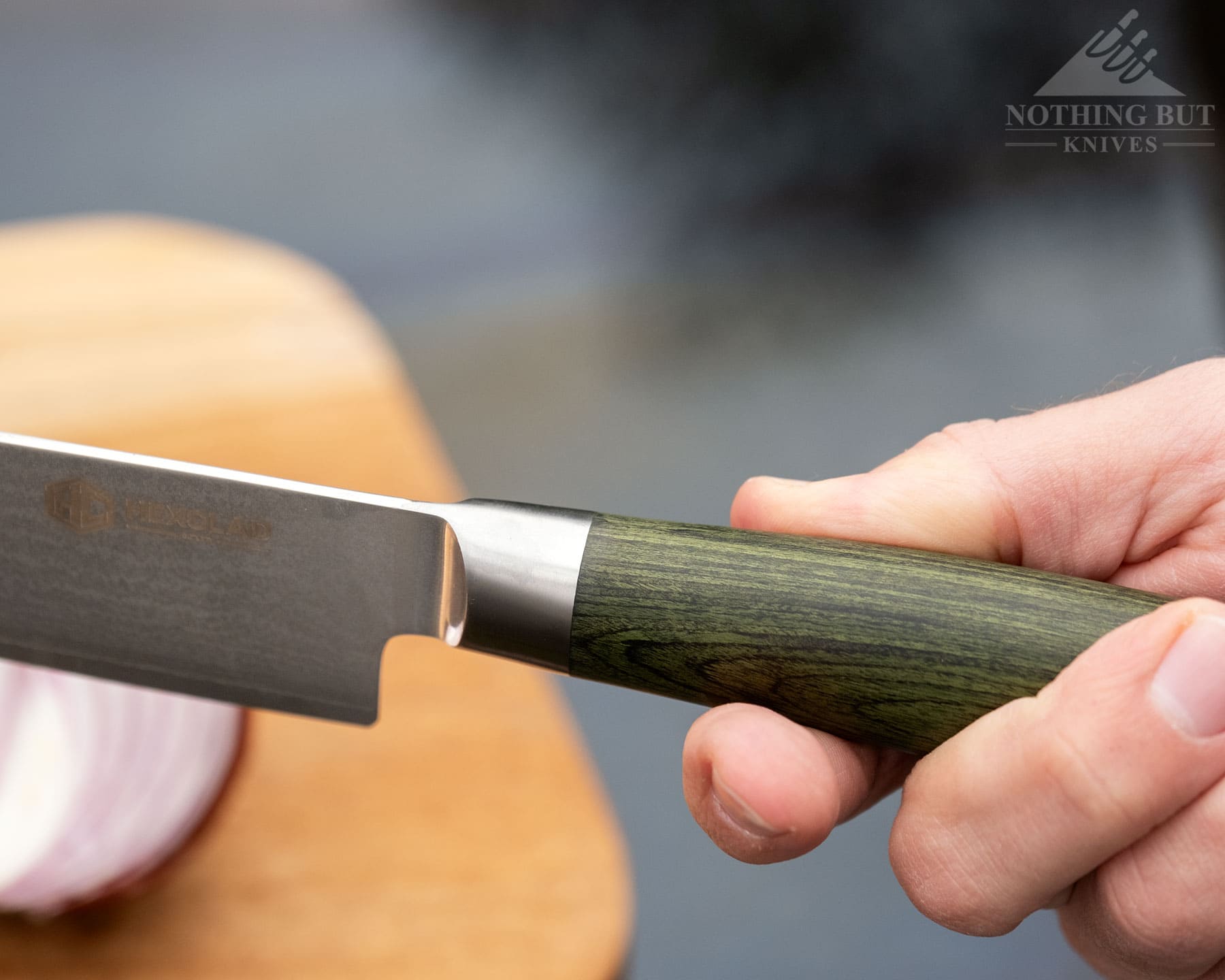
Let’s just break this down really quick: The blade shape and dimensions are mostly German. The handle style and the steel are Japanese.
The Japanese Stuff
The blade has an AUS10 steel core in 67 layers of folded steels in a way that’s not more or less considered to be Japanese Damascus. The edge is ground to 12°, which is certainly a Japanese-level of thinness for a kitchen knife. That continues to the spine, which is just about 2 mm. So the geometry is certainly in line with what you’ll find on most Shun knives.
The German/Western-Style Stuff
The shape of the blade is mostly in a western style with a more pronounced belly in the edge, and the balance sits right around the bolster. That last bit isn’t strictly a Western element but it’s a shift from a Japanese gyuto which will usually be weighted toward the blade.
The Knife is Hybrid, my Cutting Technique is Not
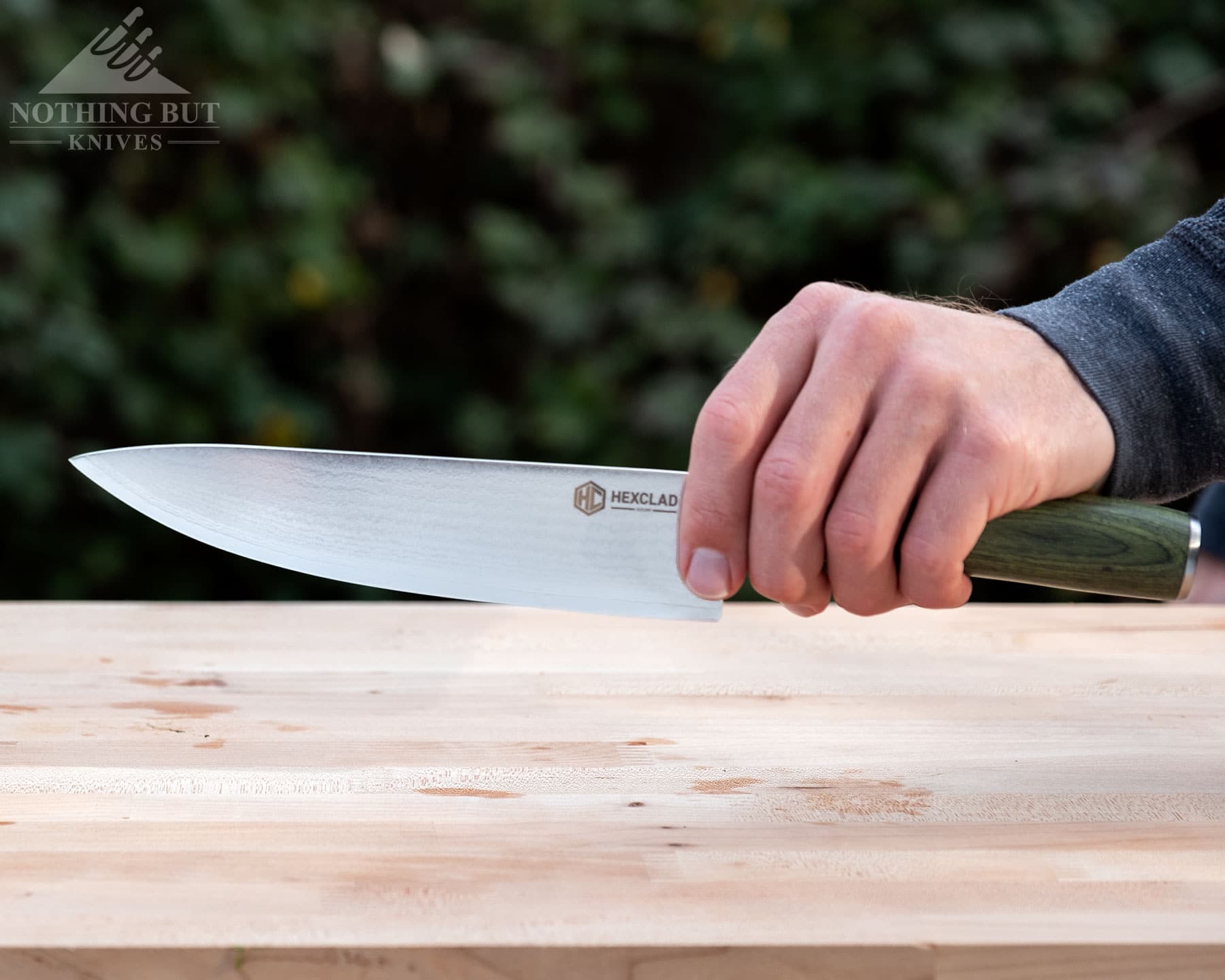
I do not like this hybrid business for myself. The shape makes me want to rock chop, but the blade just doesn’t have enough height (it’s about an inch and a half from edge to spine at the base where a typical western-style chef’s knife will be around two inches). My index finger always feels crowded when I try to rock chop.
The blade cuts beautifully in the top half, but the curve in the edge makes it harder for me to finish a cut, especially when I’m cutting up something thin like green onions.
The thinness of the blade makes me want to push cut; the outline is better at rock chopping, but there just isn’t enough material for that to actually work very well.
At least, not with the way I cut.
In Use
It doesn’t quite have the cracking qualities of a typical German knife, but it does have the bite and smooth cutting of a Japanese knife. So I ended up preferring this for cutting light and thin foods in the vegetable range, especially since the low height of the blade and overall thinness felt like a hindrance to rock chopping and working with thick or dense foods. I didn’t test it on chives, but I suspect it would great for that.
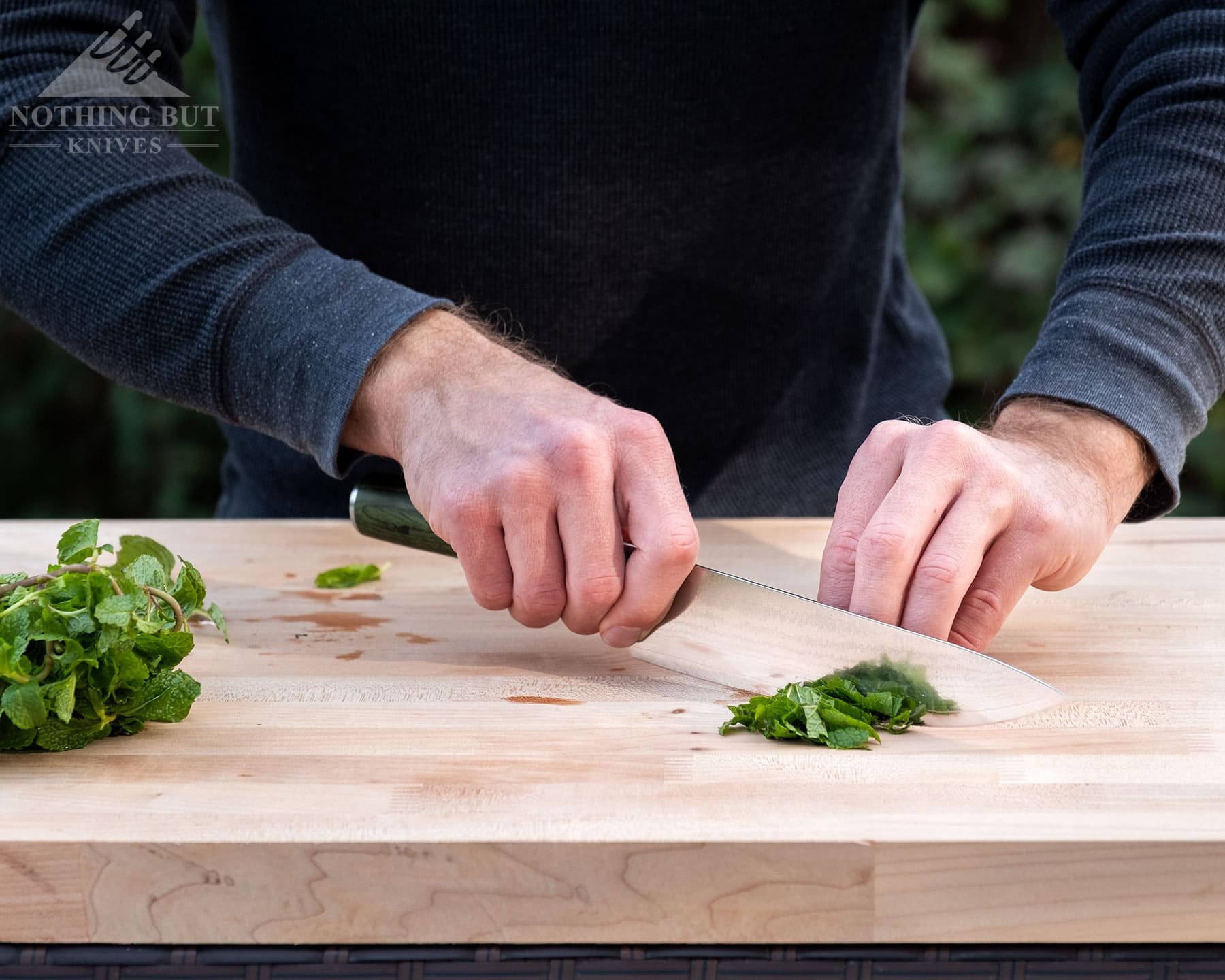
Mushrooms – I felt some resistance when I was cutting mushrooms. That particular combination of starchy softness seems to be the mild achilles heel of this knife. I was still able to slice up mushrooms just fine, but there was a rubbery feeling the whole time that I had to contend with.
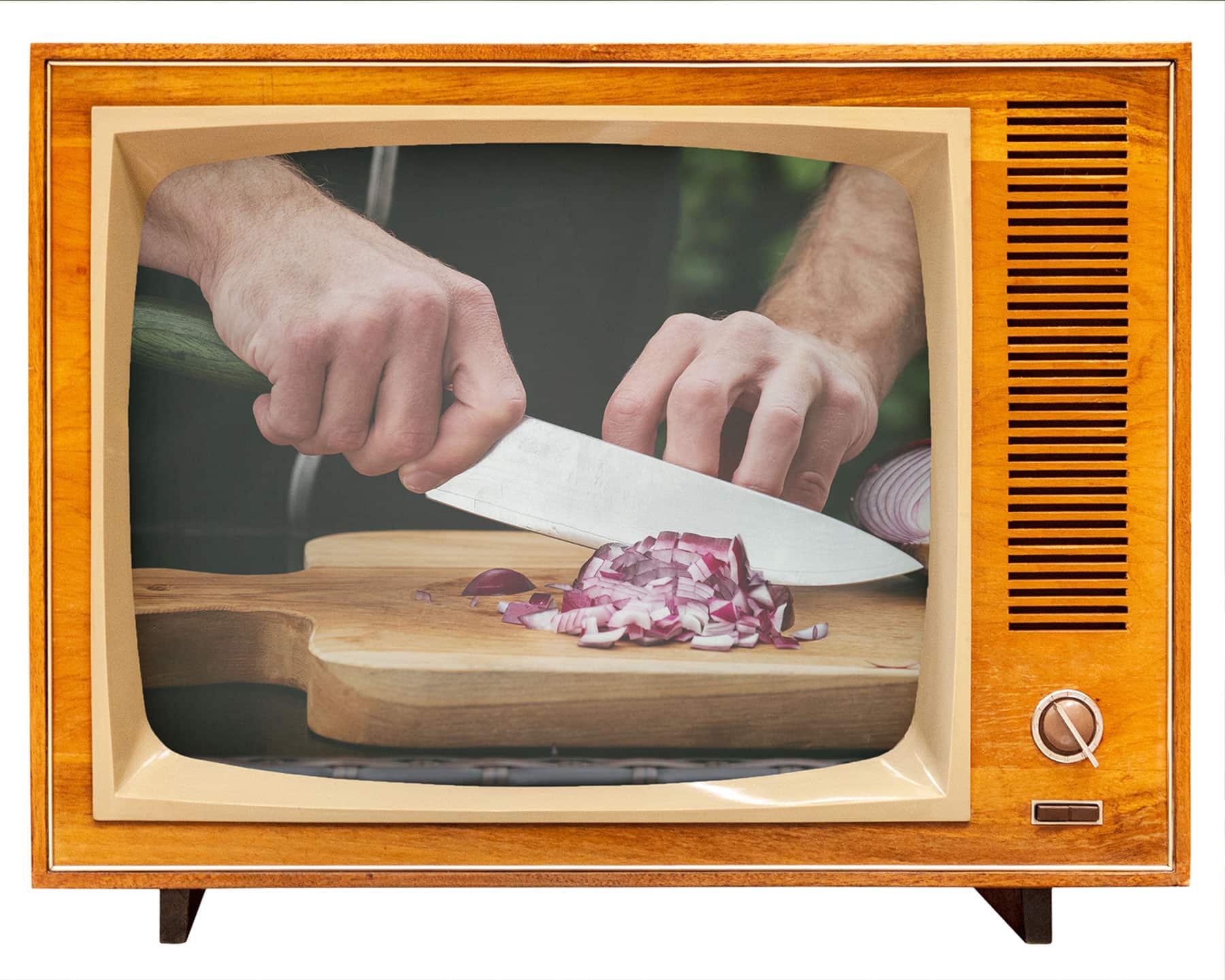
Onions – It’s better for rough chopping than dicing onions, even with the thin edge geometry. The cuts feel clean enough, though.
Green Onions – This is where rock chopping actually feels okay with this knife since I don’t have to raise the blade as much, so I get to feel the full benefit of the thin edge. I got some nice, clean cuts here.
Potatoes – I like the way it bites into potatoes. I also had an easier time making finer cubes, but I felt the awkwardness of the edge’s belly more here because it was tricky for me to finish cuts without leaving danglers.
Cabbage – It slices right through cabbage. Nothing too startling here, except it did feel more difficult to make an even cut when I first cut cabbages in half. The thin blade just gets bullied and pushed around inside. But cuts felt clean and crisp once I got it down to quarters and just needed to shave off pieces.
Comparison and Alternatives
The most clear-cut comparison to me is the Shun Classic chef’s knife. I’ve only used the santoku from that series, but I can attest to the fine-tuned geometry of the Classics and say that, for most of us, the two cut basically the same (the Shun’s might have slightly better edge retention). The two main things to look at are the D-shaped handles on Shun knives (which can be polarizing), and the price, which is usually the same between the two, but HexClad seems to run promotions more aggressively, so you probably have a better chance of finding a good deal on their chef’s knife.
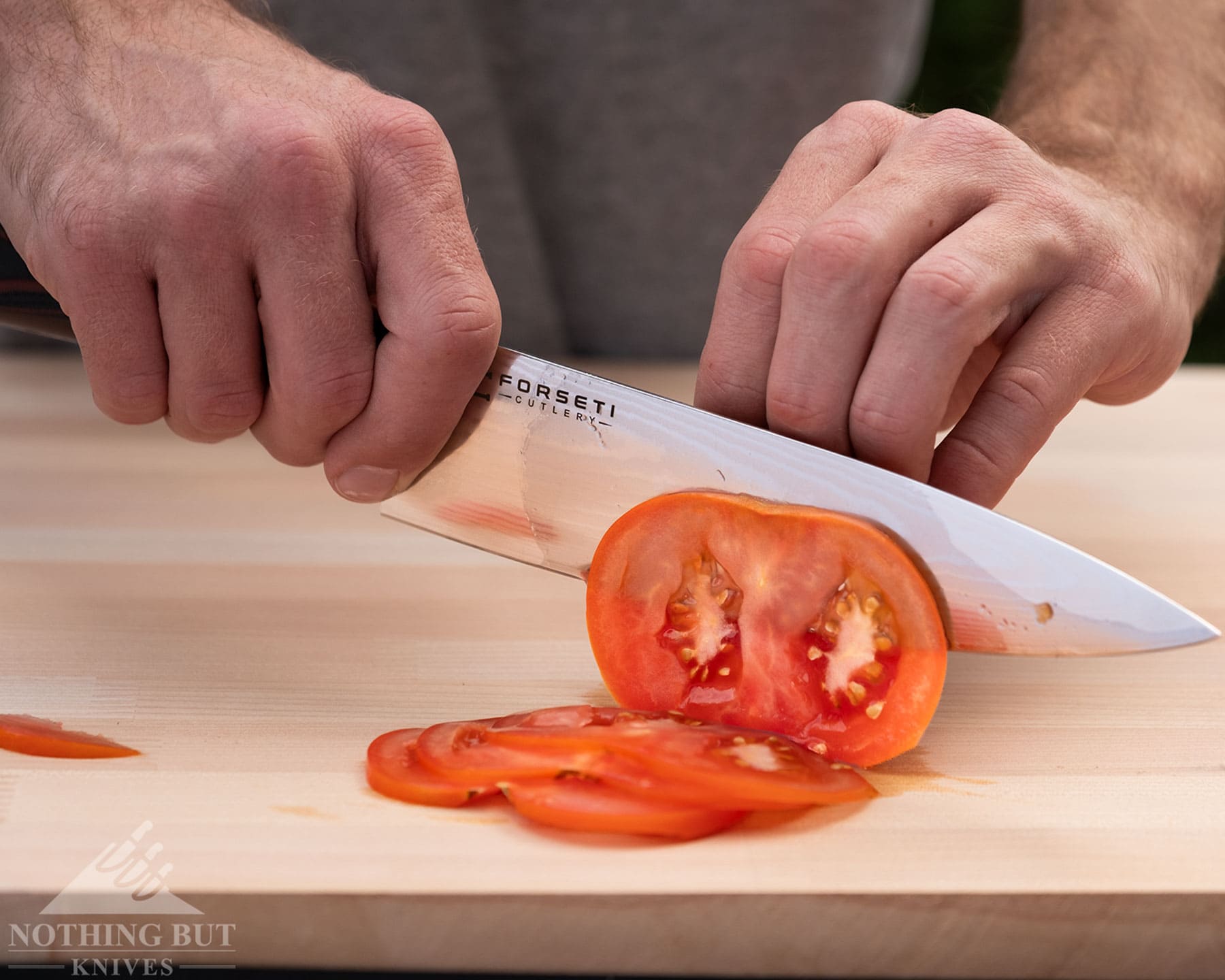
The Forseti Cutlery chef’s knife #AD is another close comparison, it’s pretty much the same concept, but it feels more comfortable to me thanks to the spine being a little more buffed at the corners and having an angled bolster. It leans a little more western since the balance is more toward the pommel and is heavier overall, and you can usually find it a little cheaper than the Hexclad knives.
From a purely bang for the buck standpoint, you get the best bargain on HexClad knives by buying the set. We felt like it was good enough deal to include in our article on Top Kitchen Knife Sets for Home or a Commercial Kitchen.
It’s Good, but It’s Mostly Functional Style
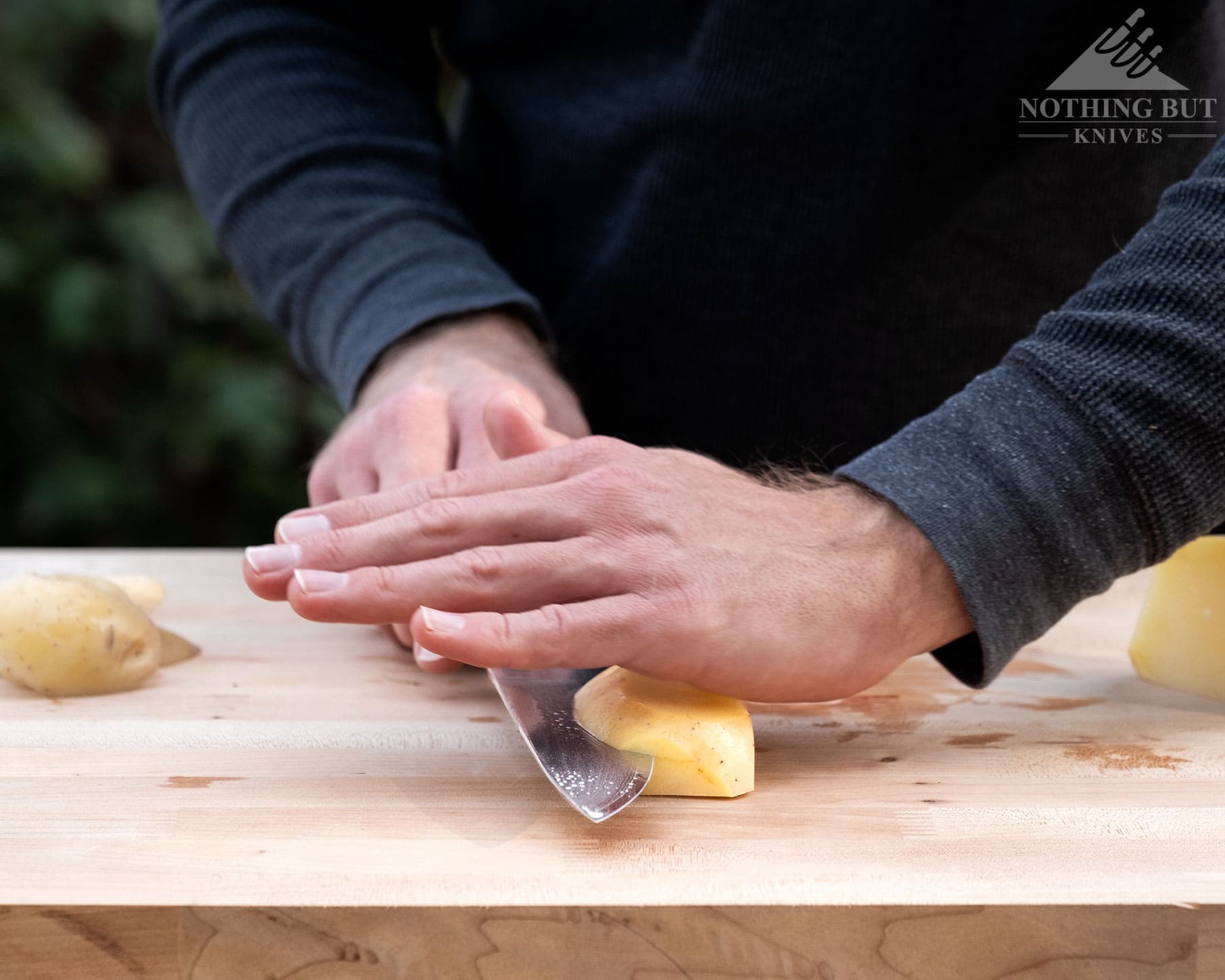
The big-sign feature of this knife, for me, is that it’s well made, has a great edge with nice Japanese steel, and comes in cheaper than most of the established high-end names. Basically I see this as a cheaper alternative to the Shun Classic series.
I like the steel on the knife, I like the handle shape and color, and I even like the way it cuts so long as I’m cutting something like herbs or leafy things.
This is a good chef’s knife. I just don’t like using it. The hybrid lines don’t work for me. I’d rather work with a Tojiro DP or even a Shun Sora on the cheap side, then snatch up a Dexter Russel knife if I really wanted something in a more western style.
But this is almost as much about style as anything. The Hexclad knife looks good and works well, and when you’re trying to make your kitchen look like you have your life together, those looks have their own kind of value so long as the thing is functional too. Hexclad does get you that, if nothing else.