TL;DR
- The Spectrum chef’s knife is good for rock chopping and rough chopping.
- The balance is mostly in the bolster, and the edge is very toothy.
- It’s a little heavier than average: about an ounce over the typical Zwilling or Wusthof knife.
- The Micarta handle adds a nice tactile feeling without being too dry, but it will still stain over time.
- The price is up there, and you’re mostly paying for looks and slightly different tactile experience in the handle, but it’s still a fine knife.
This Takes a Typical Zwilling Knives up a Notch in Style and Weight
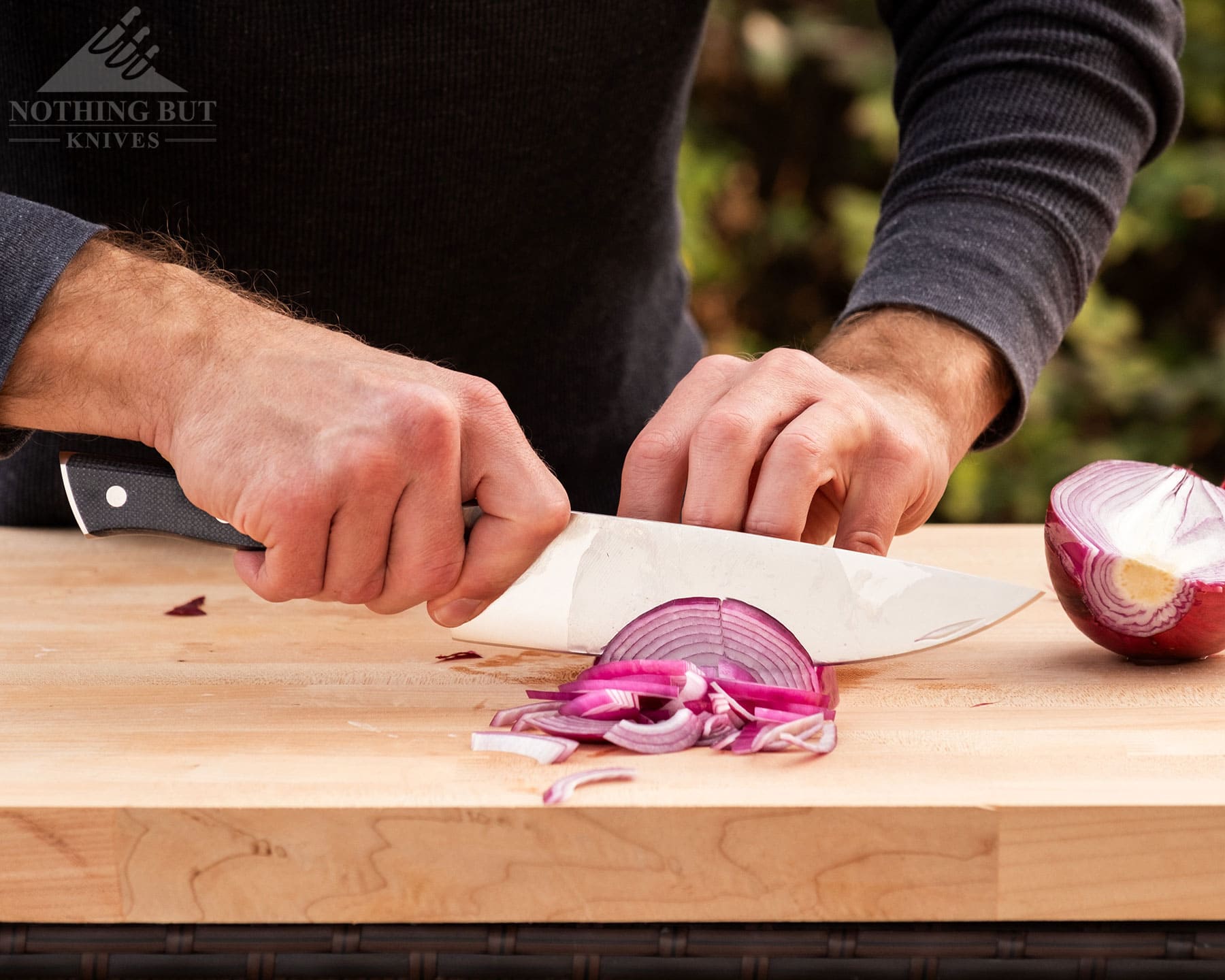
My first impressions of the Spectrum chef’s knife were that it was heavy, blocky, toothy in the edge, and incredibly good looking.
It’s also about as a German as a German chef’s knife can get, and it does all those German chef’s knives things very well:
- Rock chops smoothly,
- It’s great for rough chopping onions,
- Feels easy doing larger or oblique cuts on soup vegetables like carrots
- And it’s a beast of a thing that can handle a full bird and a little bit of bone.
If you’re familiar with German kitchen knives then you already know how this thing cuts. There’s nothing particularly different going on with the blade. The big difference is in the handle.
The heaviness might be the biggest issue. It brings up some balance issues I’ll talk about later, but I think the thickness of the handle helped me (personally) cut straighter. Paradoxically, I don’t like the weight or the feel of the handle, but it just seems to work well for me.
Specifications
| Overall Length: | 13.07” |
| Blade Length: | 7.87” |
| Blade Steel: | Sigmafroged RCF |
| Hardness: | 55 – 58 HRc |
| Blade Thickness: | 0.11” (3 mm) at base of blade |
| Blade Shape: | German |
| Blade Grind: | Full flat |
| Handle Length: | 4.65” |
| Handle Material: | Jute Micarta |
| Handle Type: | Western |
| Weight: | 281.5 g (9.93 oz) |
| Made in: | Solingen, Germany |
| What I Liked | What I Didn’t Like |
|---|---|
| The edge has a hard bite that’s brutally efficient at finishing cuts | It’s pricey, and maybe not that much of an improvement from the knife its based on |
| Size and curvature of the handle worked well with my hand | It’s heavy and the balance can feel awkward unless you really like rock chopping |
| Sloped bolsters; always a fan of sloped bolsters | Corners on the handle are a little harsher than I’d like |
The Zwilling Pro Update
The Spectrum series is more or less the Zwilling Pro design with Micarta scales and a little extra shaping in the handle design. I’ll get into the handle in more detail in a moment, but I thought it would be helpful to outline exactly what is and isn’t different here, mainly because the differences between the two were my main concern in testing the knife.
| Zwilling Pro | Zwilling Spectrum | |
|---|---|---|
| OVA Length: | 12.99” | 13.07 |
| Blade Length: | 7.87” | 7.87 |
| Handle Material: | Plastic scales | Micarta scales |
| Steel: | Friodur | RCF (recycled Friodur) |
| Weight: | 249 g (8.7 oz) | 281 g (9.93 oz) |
The really key differences are the handle material and style (which I ended up mostly liking despite the weird balance), and the weight with the Spectrum over a full ounce heavier than the Pro.
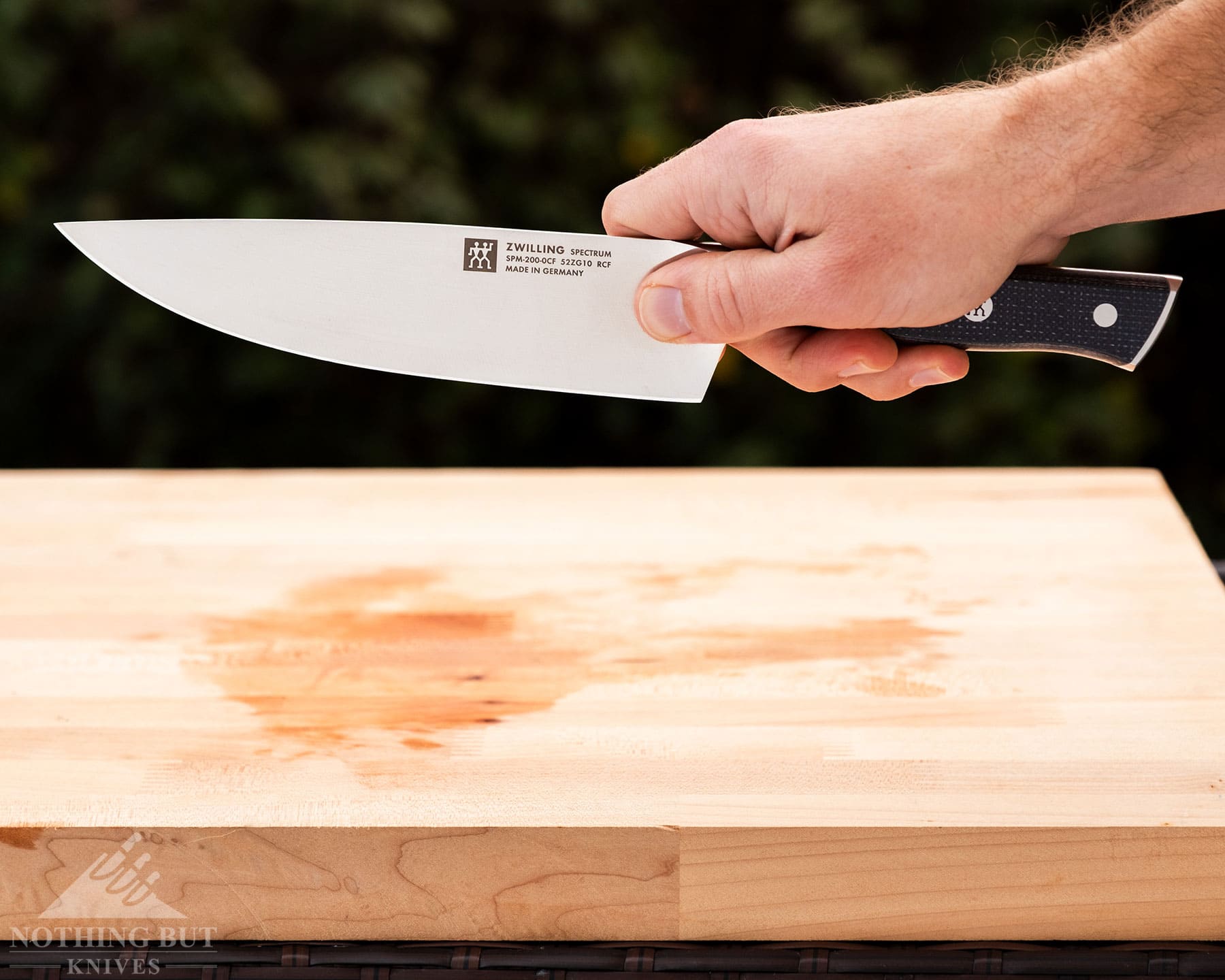
The other (and possibly most) relevant difference is the price. I didn’t include it in the table because prices change fast these days, but as of this writing the Zwilling Pro chef’s knife goes for around $170 while the Spectrum typically runs about $200.
So the big question here is whether that handle is worth an extra $30.
Heavy Ergos: Convergence of the Small and Big Hand Experience
Even for a German knife, this is heavy. The only knives I’ve tested that are heavier (that I could think of while writing this review) are the Gude Alpha and the Lamson Premier. Both of those have full bolsters, which should tell you something about just how much material is packed into the handle of the Spectrum.
The balance seems to sit right where the bolster meets the top of the Micarta scales, which puts the weight nicely around the center of my hand in a pinch grip. I liked the feel of as I was rock chopping, but sometimes it felt unwieldy as I was shifting to other tasks, like the handle was pulling back from the pommel.
There are Facets to this Handle
It’s not really fair to just call this handle blocky. There’s some clever shaping on this thing:
The top has a nice sloping curve that transitions into the steel bolster which is right where my middle finger usually wraps in a pinch grip. The back is also rounded so it seats pretty comfortably into the palm of my hand. There are so many more curves in this handle than I thought there would be based on pictures.
But they also ground the sides of the Micarta scales almost completely flat which gives the ergonomics an overall impression of holding a cuboid. It works, although I do wish they had rounded the corners a little more, because after using the knife for about half an hour straight the edges of the handle start to irritate my hand a little.
What about the Micarta
This isn’t a material I come across a lot in the kitchen knife world. As much as I like the look and feel of Micarta, I’m always wary about using it around a lot of food because of how it soaks up liquid and oil. If done right it can make the handle more comfortable and grippy, but in a way that I’m not necessarily seeking in a kitchen knife.
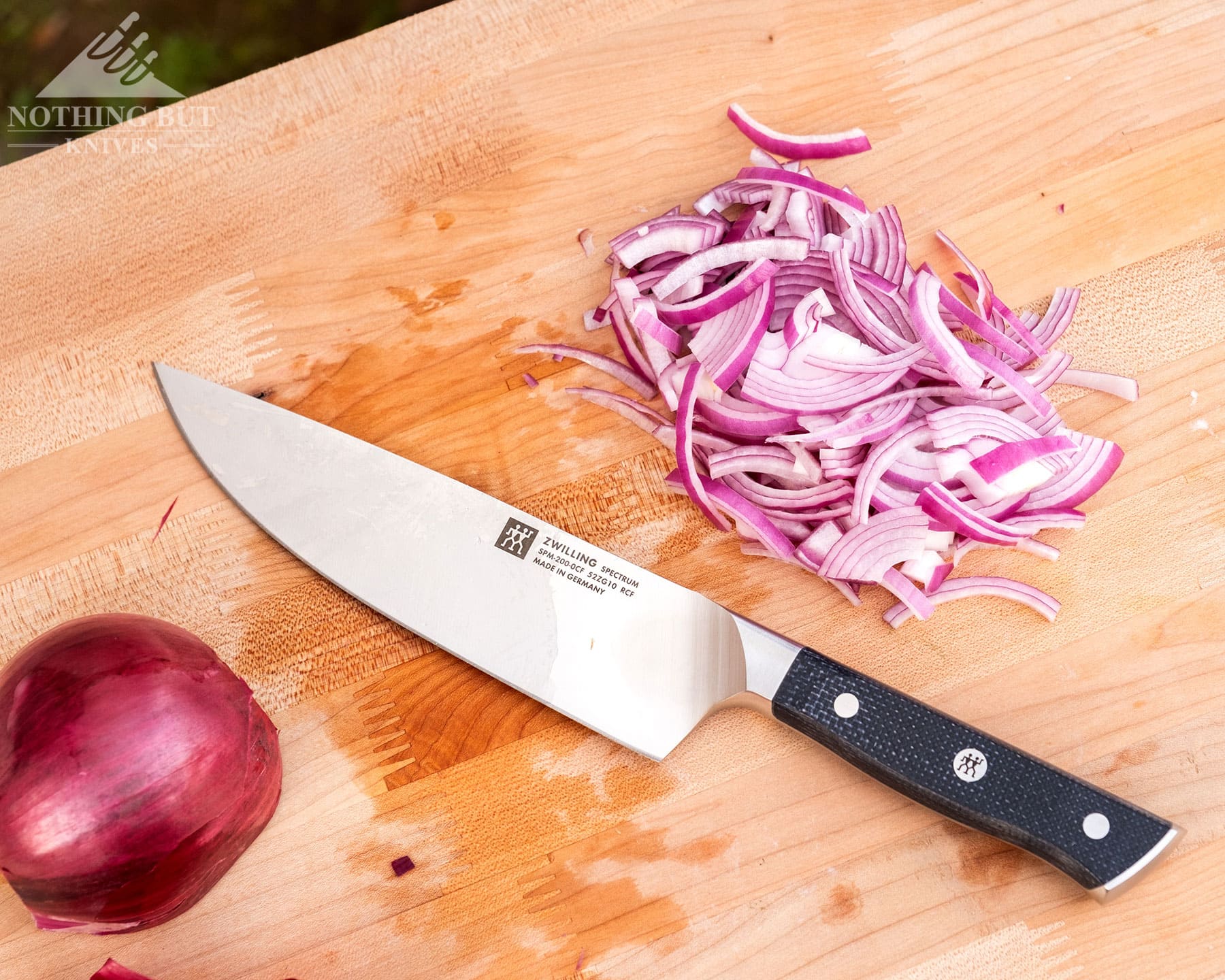
Because of that, I expected them to pack this thing with resin and make it as smooth and polished as possible, but the texture is surprisingly tactile. Some of the cloth feeling actually comes through right on the verge of feeling rough. If this were a camping knife I’d say it was still too smooth, but it seems like a sweet spot on a kitchen knife where there’s enough polish to help keep oils from soaking in too much while still giving the user a little more of the natural feeling Micarta is good for.
In the long term, this handle will still form some patina-like spots. The color is dark enough that they won’t be obvious for a while. I still have trouble spotting any discoloration after using and washing the knife several times over a couple weeks, but it will definitely develop more character over time than your typical poly-plastic option.
Notes from Smaller Hands
I have wide weird-shaped hands, so I asked my wife to take a few runs with the Spectrum and tell me what she thought:
It cut great but for her, but it felt heavy and unbalanced, which was no surprise to me.
The transition from the blade to the handle feels kind of awkward, and because of the weight, she had to hold up higher on the blade to get the kind of control she wanted, which made it feel even more unbalanced.
Her concluding takeaway was that the Spectrum feels like it needs to be wrestled.
She still seemed to like it in theory, though. She actually asked me later if Zwilling makes a smaller version of this knife, and when I told her they make a six-inch version of pretty much all their chef’s knives she got a sort of final-puzzle-piece expression on her face and said that sounded like it would be just about perfect for her.
So I’d actually put that forward as an option worth considering if you like the look of the knife, but are worried about the weight. I suspect the balance would be more manageable for smaller hands on the six-inch version, and that size should be good enough so long as you aren’t planning to use it in a professional kitchen.
In Action
As a heavy knife with a toothy edge there is a feeling of certainty that no matter what I’ll be able to cut whatever’s on the table. I never really feel fast with the Spectrum. At best, I feel steady. But I found that I liked it at extremes: rough chopping big root-like vegetables and mincing fine herbs.
Tomatoes
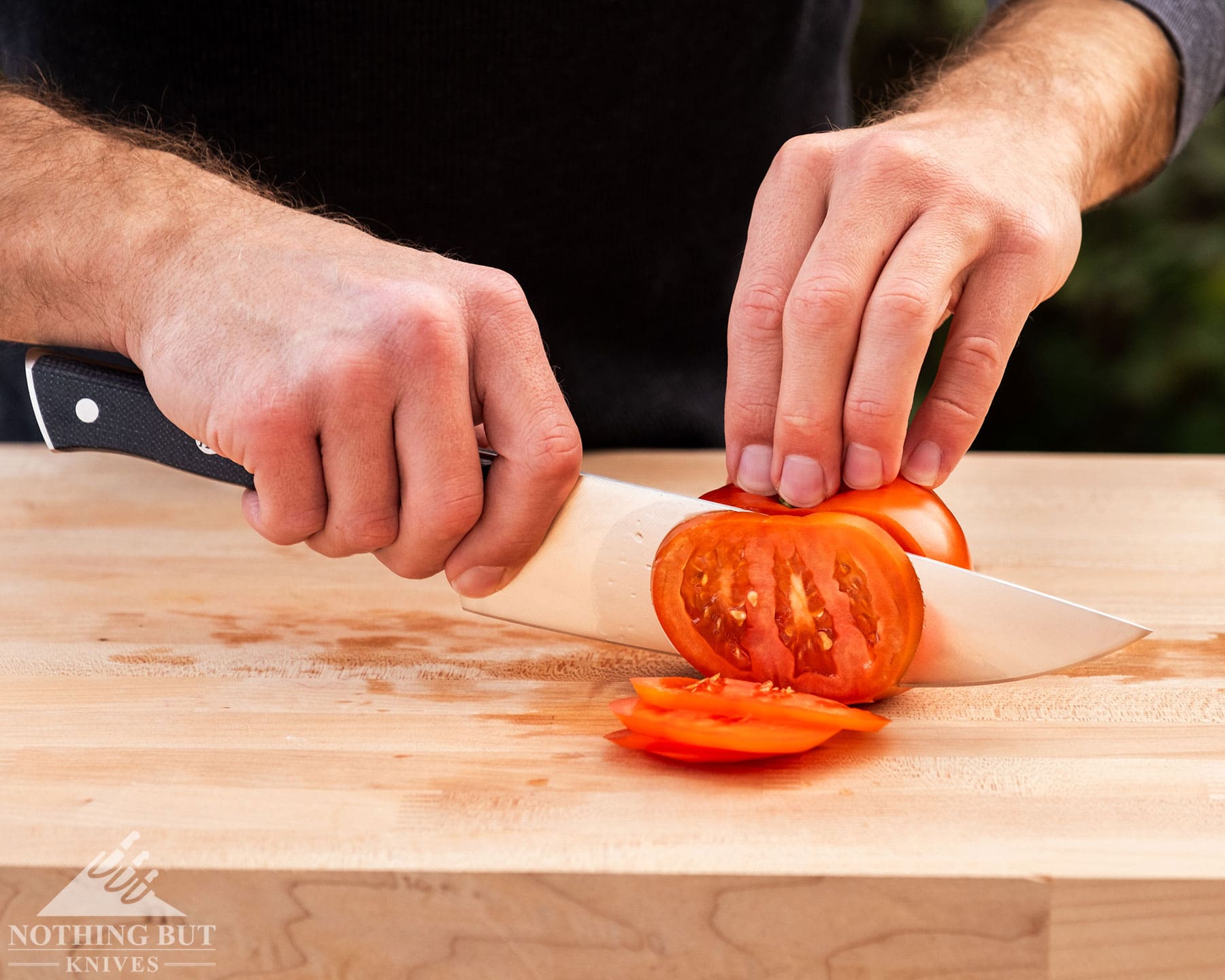
The way it cuts tomatoes was a pleasant surprise. The toothy edge breaks the skins easily, and the follow through feels smooth enough. It doesn’t glide so much as plod, but it’s a nice steady plodding. I don’t think I could get paper-thin slices with this knife, but two to three millimeter cuts aren’t any problem.
Onions
No surprises here. The Spectrum is really good if you just want to rough chop something. I found it more difficult to get smaller diced sizes. My preference when I’m making pico de gallo or guacamole is to get onions and peppers down to more of a brunoise size. The most consistent way I was able to get there with the Spectrum was to go over the cuts with a rock chopping motion a few times.
I just couldn’t get the staging cuts as close as I like because the thickness of the blade just doesn’t want to move through a whole onion like that. Once I get to a place where I’m rock chopping near the heel of the blade, though, the world opens up.
Serrano peppers
The peppers I was cutting were well aged and on the softer side, so the initial split was a little tricky. The edge cut fine, but it’s difficult to line up a knife this thick with the small size of peppers I was working with. It was like trying to push a piece of cooked macaroni around with a chopstick.
But, when I got down to mincing, the knife started cutting with more authority. I found it really easy to keep my cuts consistent and make them actually complete.
Herbs (mostly cilantro)
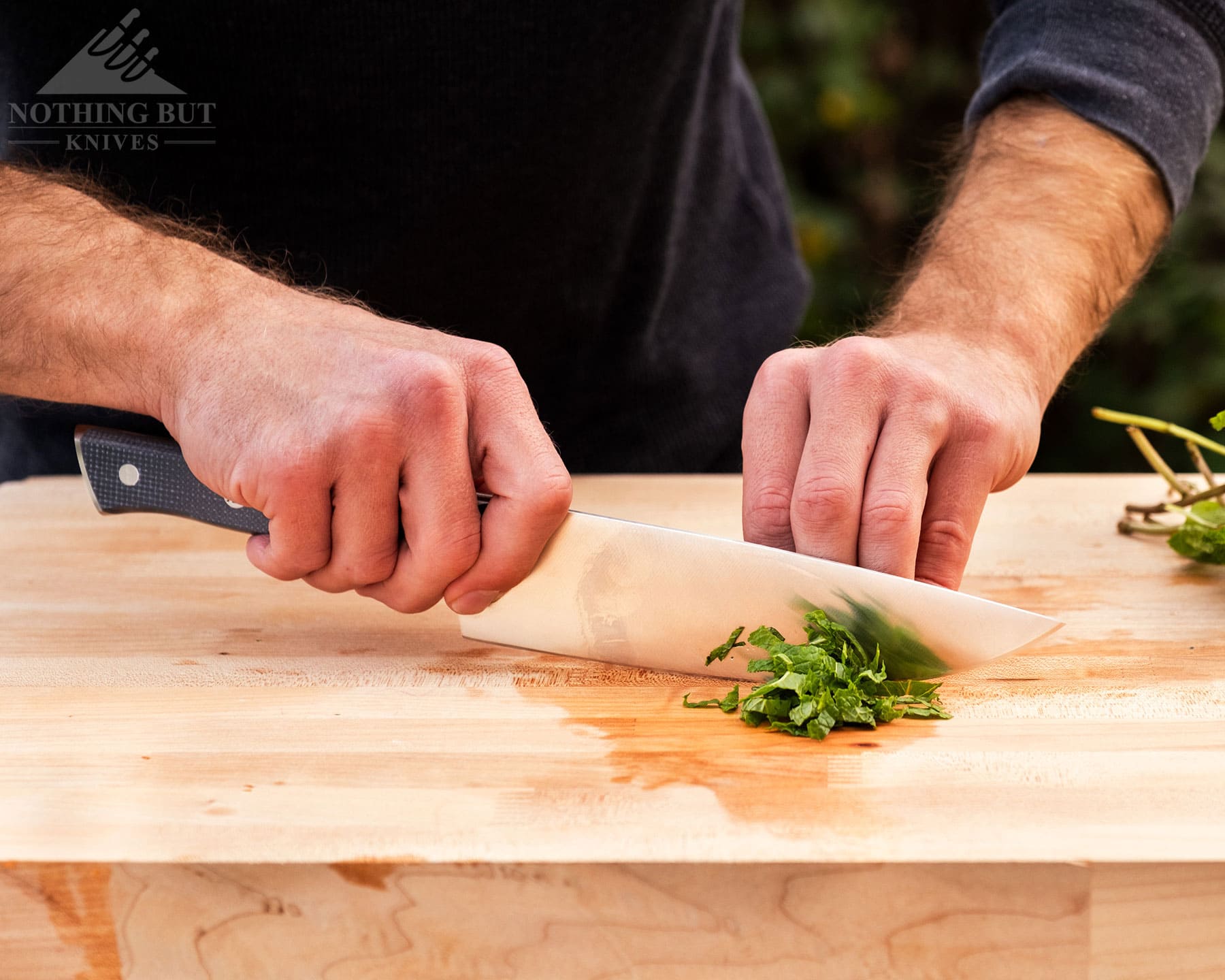
I never felt certain that I was finishing cuts as I was working, but by the end of cooking I didn’t find much in the way of accordion cuts.
I also ended up mincing up some mint, which isn’t something I normally do, or ever do really. But we accidentally grabbed mint instead of basil leaves when we did a cooking shoot for this knife. After that little goof I would rate mint leaves as quite a bit harder to mince or chiffonade than basil because the leaves are so delicate, but I managed to break them up pretty easily despite my general incompetence.
Comparison and Alternatives
Putting the Zwilling Pro aside as the the sensible and slightly cheaper alternative, I see two obvious comparisons:
The Wusthof Classic Ikon has a different approach to the handle that I don’t personally like because it’s round and tends to turn in my hand, but it seems to work for some people. If the blockiness of the Spectrum scares you off, the Classic Ikon seems like the opposite direction.
The Kramer by Zwilling Carbon 2.0 would be the way to go if you really want a fine-cutting blade along with a super comfortable handle. I’ve only used the earlier iterations of the Essential Collection, which is discontinued now, but the design of the new stuff looks close to what I’ve used for me to make an educated guess that they feel and cut about the same.
If all these recommendations are looking too rich for your blood, though, you’ll get by just fine with the Bavarian Knife Works chef’s knife. They’re mostly classic German-style knives with a similar handle shape to the Spectrum, but they’re lighter and don’t feel as blocky.
I also like the Cangshan TC as an option here. Stylistically it’s different, but it’s another example of a blocky handle that still feels comfortable, and the weight is comparable. Also, critically, it’s much cheaper.
The Spectrum Chef’s Knife is Heavy, and Blocky, but Stylish and Effective
This is a solid German chef’s knife that’s on the heavier side. I love the look of it, and learned to like the feel of it, and the Micarta scales actually feel like a nice addition that brings some pleasant texture to the grip and make it a comfortable knife despite the (slight) need for the corners to be rounded out more.
The real sticking point is probably the weight. If you have hands on the larger side, this should be a comfortable knife for you, but I’d be hesitant to recommend it for use in a professional kitchen because that extra ounce of weight will add up over the course of a full shift.
But if you’re looking for something nice but tough with a good edge and a little more handle to grip, the Spectrum hits all those points beautifully.