
TL;DR
- Works great as a camping knife: It slices okay, but it’s great for processing wood
- It’s very comfortable, and feels nimble in the hand.
- The sheath is well formed, and makes for a good scout or appendix carry (rides too high as a vertical carry, though).
- The edge holds up well to abuse.
- The price is the biggest sticking point.
This Camping and Hunting Hybrid from MKC Left a Good First Impression

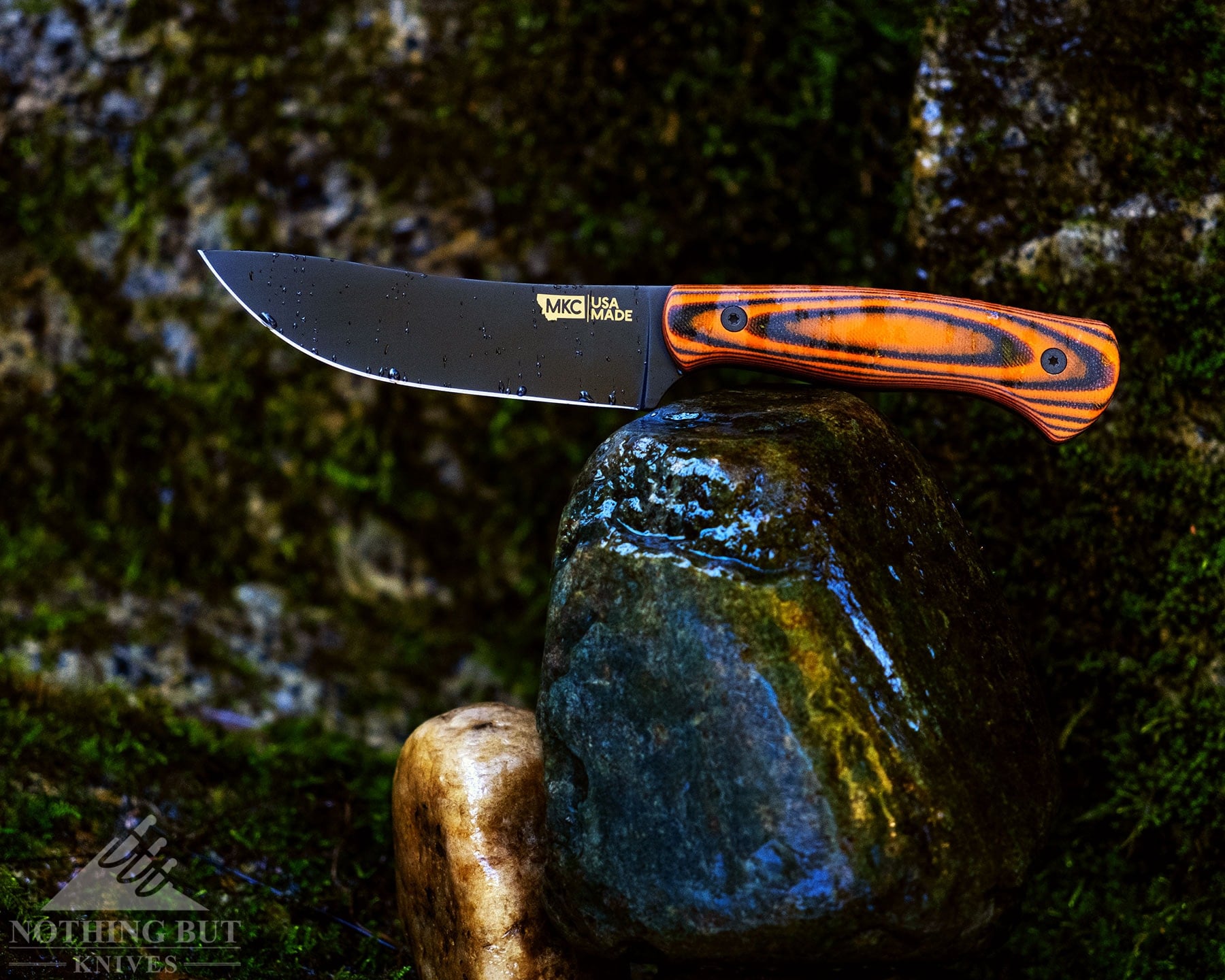
This was made to be a skinning knife with a little more heft so it doubles as a camping knife. I pretty much only used it as a camping knife, unless you count opening packages holding fragile material to be an acceptable substitute for skinning.
I liked using the Stonewall Skinner a lot more than I expected. It’s a great, mid-sized camping knife, but I wasn’t expecting a whole lot, I think, because nothing about the look really excited me, and I was skeptical of MKC’s pricing (I’m still wary of it, but maybe a little more understanding)..

It’s a tricky thing to talk up, though, because there’s no one specific thing I can point at to make the Stonewall Skinner stand out from any number of other hunting or skinning knives; it’s just a good knife. A nice design executed well, so that it’s a little more than the sum of its parts.
- The edge has an aggressive cut and great retention,
- They used tough steel and compensated for one of its few drawbacks with a nice coating,
- The handle helps your grip in almost every position,
- And it works great as a horizontal carry knife.
Specifications
| Overall Length: | 9.25” |
| Blade Length: | 4.625” |
| Blade Steel: | 52100 |
| Blade Thickness: | 0.14” (3.5 mm) |
| Blade Shape: | Drop point (technically) |
| Blade Grind: | Full flat |
| Handle Material: | G10 |
| Weight: | 5.53 oz |
| Made in: | Montana, USA |
| What I Liked | What I Didn’t Like |
|---|---|
| Blade cuts like a dream | Full bolster will make long term sharpening a pain |
| G10 handle is comfortable with spot-on texture | The handle rides too high and too close in the vertical position |
| Sheath rides well as an appendix carry | The price is hard to contend with |
That Thing
I was a little confused by Montana Knife Company at first. Not about what they do so much as why they are so successful in doing it, because from afar it looked to me like they were making pretty run-of-the-mill fixed blades. Maybe the aesthetic is a little different with the black and orange handles (which, to be fair, is a great approach to high-vis handles), but other than that, I couldn’t pin down anything that made them really stand out. Frankly, I thought most of their designs looked boring.
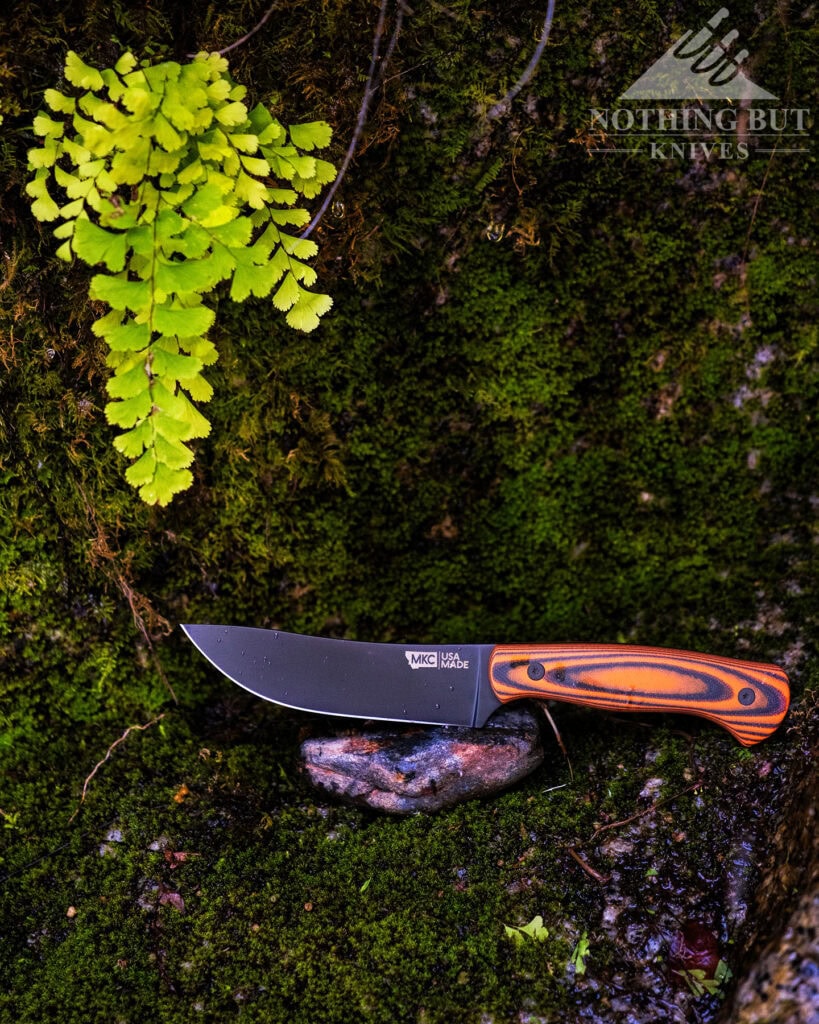
They’re a US-based company that seems to make or source most, if not all, their products within the states. But, hard as that is to do these days, it’s far from unheard of. They’re swimming in waters with the likes of Buck, Ka-Bar, White River, and L.T. Wright, and pricing themselves into the territory of the last two. That’s a high stage to try climbing onto.
Part of the answer to that question, of course, is marketing acumen. They hustled like crazy to get their knives in the public eye and the work paid off, clearly. But I’ve found the other reason now that I’ve held a couple in hand: Their knives just have that thing.

“That thing” is the feeling you get when you use a knife and makes you say “yeah, this is ride-or-die”. It’ll work and feel good working. It was meticulously shaped and workshopped to be used and abused for years, and all the little nuances of the deceptively simple-looking shape add up to a tool that just feels good to use. It’s not unlike the feeling I get when I pick up a knife from White River.
Now whether or not that feeling is worth the price, I’m actually still not sure, but we’ll get into that in the Alternatives section.
Cuts Well and Just Keeps Going

I was so certain this thing was going to cut sloppy, but if the three-foot-tall of neat cardboard squares by my recycle bin are any indication, the Stonewall Skinner just has fantastic edge geometry despite the thicker spine.
- It carves up wood, both for taking out larger chunks in a chest lever, and finer carving for making feather sticks;
- It chops okay. The edge does decent work here, but the handle helps a lot too thanks to the shape of the pommel;
- And it’s just tough. Not only because of the thickness, but the steel seems to have been treated to a sweet spot that makes the edge very stable.
They gave this thing a nice toothy edge that cuts wood and paper with a satisfying smoothness.

Sometimes it feels like the thickness behind the edge slows down my cut when I’m working through cardboard or canvas, but I can typically get the work done without too much strain.
The Alloy Steel
It’s a fantastic example of what 52100 steel is capable of when done well. I really had to put some work into getting the edge to dull, and it’s pretty responsive to green compound on a strop.

I don’t see a whole lot of 52100 steel out there in the production world, but it’s not a bad choice, so long as it’s treated well. That’s true of any steel really, but more so for high alloy steels like 52100, because things can go horribly wrong with it, but in the right hands it almost acts like a super steel.
The DLC coating is doing a lot of work on this blade. Since the blade is technically sporting an alloy steel, it’s not fully stainless, so the coating is a nice touch. MKC didn’t go light on it, though, and it seems to leave enough texture to hold onto things in a weird way. It doesn’t stain, but the way tape gunk or wood scrapes stick to the blade feels almost gummy when I clean the blade.
Not Quite a Nessmuk, but Close Enough

Trying to find good comparisons for the Stonewall Skinner made me regret with new vigor that I don’t have a more traditional nessmuk design, because that feels like the direction this knife wants to go. It just stops a little short with the slight impression of a hump before the tip.
It certainly matches up in use case as a hybrid hunting and bushcraft knife, but after looking at it next to a few other knives, I think I have to concede that it’s closer to a scimitar pattern.
That won’t stop me from comparing the Stonewall Skinner directly to the Spartan-Harsey Nessmuk, though, because I think the two are slight adjustments for the same use case to the point that they even have similar drawbacks:
- Both are hefty with a lot of weight towards the handle.
- Both have thick blade stocks that help it hold up to chopping, batoning, and other hard-use tasks.
- Both feature blades with pronounced bellies in order to create a slicey cutting action in spite of (or to compensate for) the thick spine.
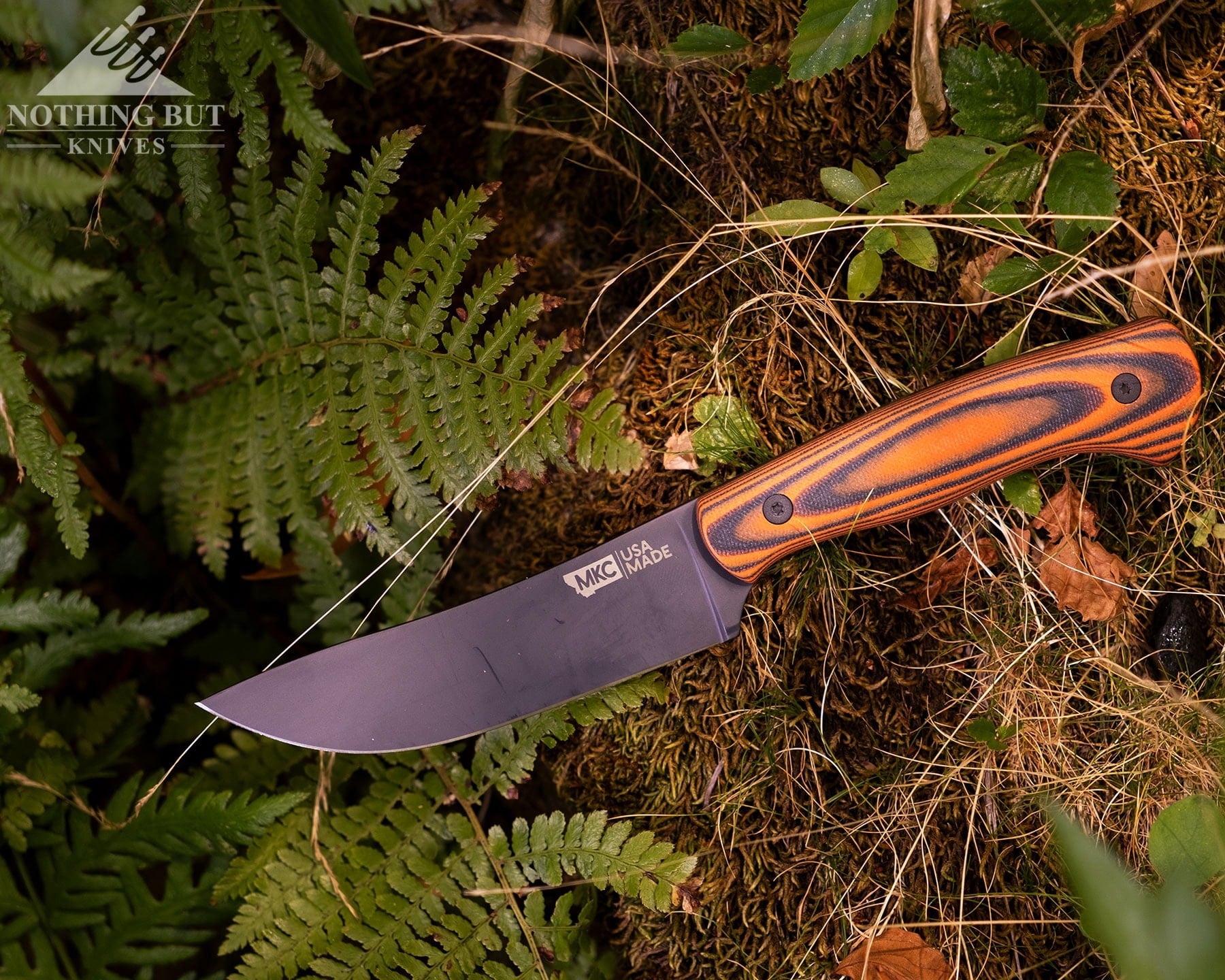
But I think in order to be a proper nessmuk blade, the tip would have to drop back down beneath the spine. As it is, the blade has more of a deep indented curve which serves well to house the thumb rather than the nessmuk hump.
So it’s not a hill I’ll die on. I’ll barely even climb the hill except to say that the Stonewall Skinner feels almost like a nessmuk, but really it’s more of a small scimitar.
The G10 Handle is Doing the Best a G10 Handle Can
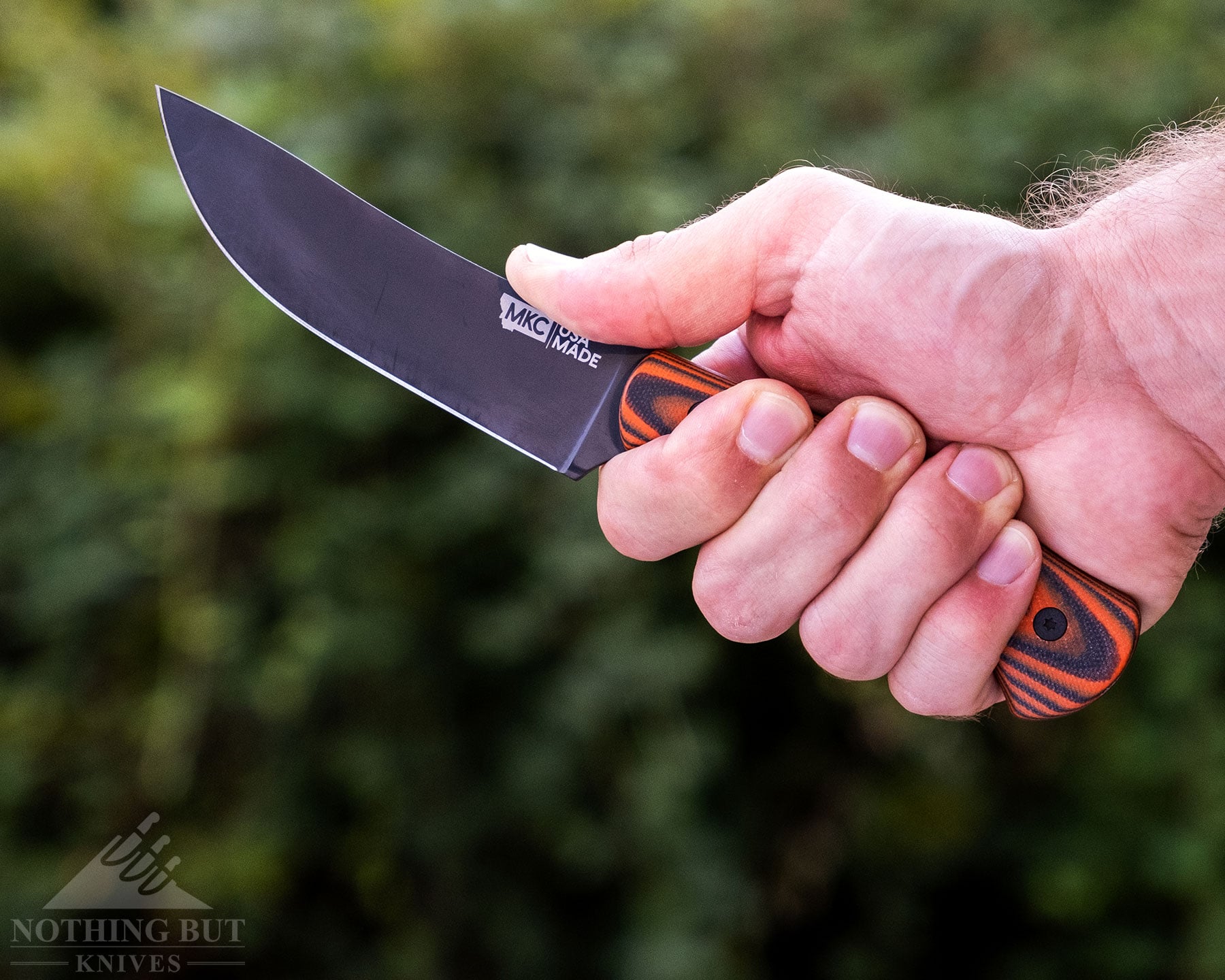
I gotta say, this handle feels just about perfect. The way they textured the scales makes it feel pretty close to a dry canvas Micarta (or as close as G10 gets). White there’s no obvious texturing like milled lines or big hexes, there’s a bit of subtle grit, almost like wood that’s been sanded but not finished.
The handle and the balance are what really made me start thinking differently about MKC. This knife puts a lot of the weight into the handle, and makes it feel manageable. So, the Stonewall Skinner feels nimble. It also has a neutral shape with the kind of curvature that gives the hand just enough comfort and leverage to make every grip feel strong and comfortable before becoming so “shaped” that it’s intrusive.
Another Sheath Done Mostly Right

Just about everything with the sheath hits right.
- The retention is spot on. It’s plenty strong enough to hold the knife even when it’s mounted upside down, but the knife still comes out easily with a push of the thumb.
- It has a retention screw, which I didn’t end up needing, but it might be nice to have down the road as things wear out.
- There are plenty of slots and holes to match up with different carrying solutions like Tek-Lok and maybe even Ulticlip (although the Skinner seems a bit heavy for that solution).
- And it comes stock with a large belt loop in the horizontal position, and can be adjusted easily with a phillip’s screwdriver.
As far as I’m concerned, they got all the important things right, so I don’t have complaints about the sheath so much as nitpicks.

The belt loop is oversized for how I typically carry it, which is on a normal belt. That leaves a lot of room for the knife to flop around. Thankfully the weight of the knife keeps it pretty still, but I think if I were to take this out with any regularity I would probably put something on it that fit tighter.
The only complaint I have here is that it’s awkward as a vertical carry. The handle rides too high and runs right along my ribs. I can feel it every time I shift my upper body and always had to be careful about how I knelt down or bent over, and especially if I was climbing anything, because the handle was always threatening to punch my side. I tended to carry the Skinner in the horizontal position on my belt much of the time.
Comparison and Alternatives
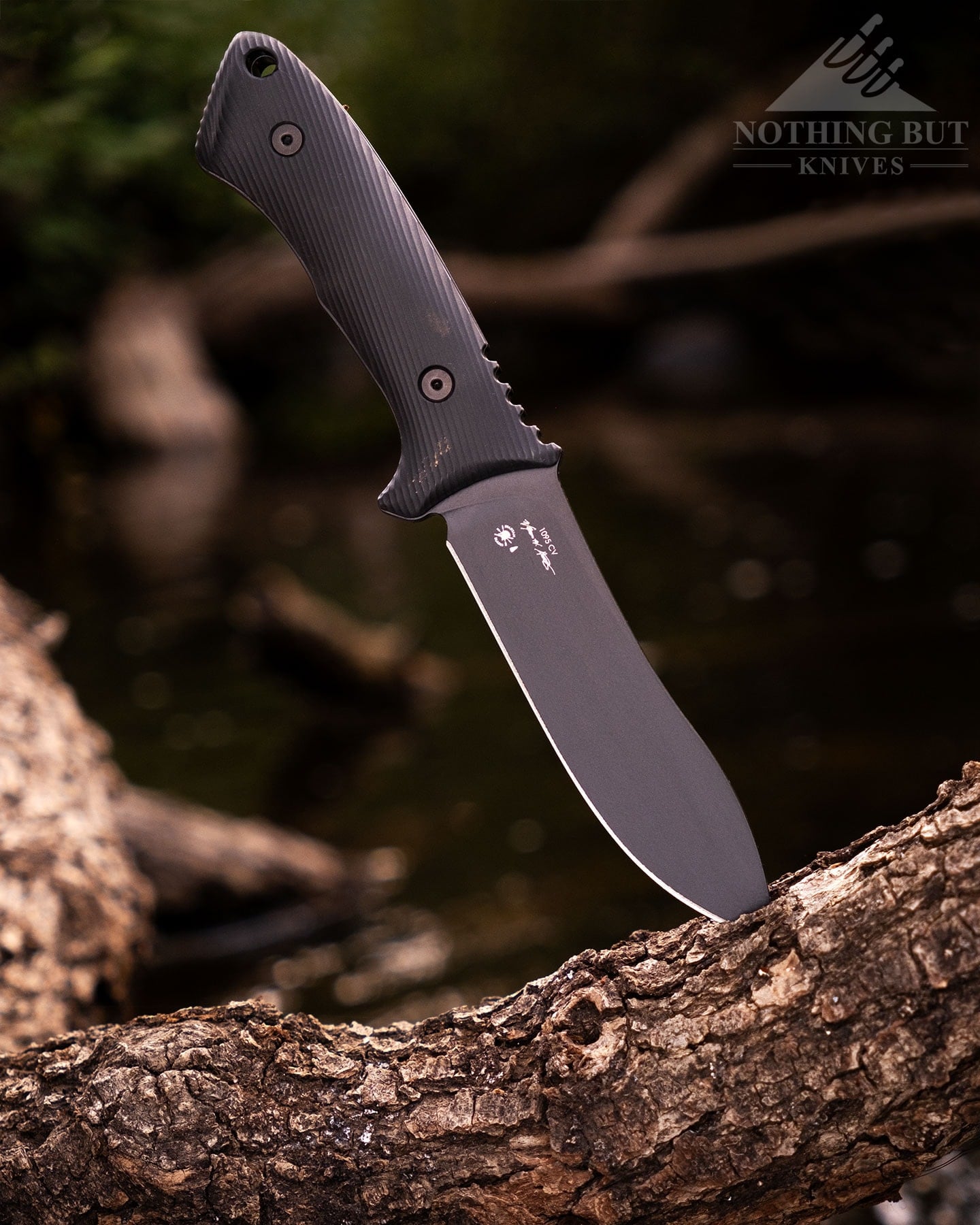
There are two knives hunting-design knives that I loved using for general campsite tasks:
I talked at some length about the Spartan-HarseyNessmuk. I’ll reiterate here that it’s a good comp if you want something a little bigger and more camping-specialized.
The Buck Compadre is both a fine slicer and a surprisingly good tool for batoning. It’s a little harder to use for making feather sticks because the edge wants to bite deep into the wood, and the steel is pretty soft so the edge rolls easily. But it’s a tough knife that cuts great and has one of my favorite Micarta handles ever.
For more of a budget option, the Off Grid Backcountry is a solid direction. It gives you a firm (if somewhat harsh) grip, a great edge, and it comes in a drop-carry sheath that rides as close to perfect in the vertical position as I think a sheath can get.
A Good Camping Knife with a Tough Price
I love this knife for myself. My use case doesn’t involve too much hunting. All the elements of a good hunting knife seem to be there:
It cuts aggressively, the edge retention is great, it seems capable of handling a bit of abuse, it feels nimble and comfortable in multiple positions, and it rides well on the belt.
There is some thickness behind the blade that might make it feel weird on certain kinds of game with thinner or looser skin. But overall, I can’t say enough good things about the blade.
I have to reign in my enthusiasm at the price, though. Even as knives across the board are becoming more expensive, MKC’s Stonewall Skinner is on the steep side. It’s not hard to find something comparably functional for a third of the price. The overall feeling of the knife makes a strong argument for justification, but I’m not sure it’s strong enough. The recently announced release of the Montana folding knife proves that MKC is committed to keeping prices at a premium, and it’s tough to argue considering many of their knife designs are sold out most of the time.
After using this knife for a while I know at least some of that price tag represents careful manufacturing and a highly skilled workforce. It might also represent a concerted effort by a new company to accrue capital and establish itself as a manufacturing mainstay of the knife world. Whether all that is worth the price is ultimately up to your and your bank account. All I can say is that, at the very least, you will get a solid knife out of the deal.


I first noted MKC knives and their sponsoring on the Clay Hayes (ALONE Season 8 winner) and MeatEater YouTube channels. From what I’ve seen, in particularly on the Clay Hayes channel, these are all great knives that have proven themselves in the field and on the hunt. No questions about that.
As for the price, yeah, I can see why it’s at that level. I am all for made in the good ole US of A.
But, I have stopped spending hundreds of dollars on knives that might end up being lost, stolen, confiscated, or just gifted away. All of which have happened to various high-end knives that I’ve owned. Which has lead me to where I’m at now…
I’ve been a knife-nut since I was a kid. Growing up in the 80s, I’ve always been aware of Cold Steel Knives. But I just never really gravitated towards them for whatever reasons. Up until recently, that is. Now, as a full-blown CS fanboy, I have really appreciated their “bang for your buck” value. Even though they’ve been sold off and gone corporate, and despite their overseas production, CS is still owned by a US company.
In saying all that, I’d like to humbly make a very competitive option to the Stonewall Skinner by Cold Steel: the Master Hunter in 3V. The MH already has a long, proven track record. And despite the fact that it is manufactured in Taiwan, it is still made with American CPM-3V steel.
I picked up a couple Master Hunters in 3V off of eBay over a year ago at a cost below $90.00 for each. Talk about bang-for-your-buck. I gifted one to a good friend. The other MH that I kept got a RK Custom Kydex sheath with a Tek-Lok for horizontal appendix carry.
I could probably make this lengthy comment even more lengthier by going into a detailed comparison. But I think I should leave that task up to you and your brother for a future review of the Master Hunter in 3V. Just sayin. Side note: the MH is also still made in San Mai III.
As always, a solid review, Andrew. See y’all on YouTube and Instagram.
Jaime @jldarchery
Great insights, Jaime. We have had a lot of folks recommending the CS Master Hunter, so I just ordered one. Thanks for giving me the nudge I needed.